



How Not to Make These Common (and Silly) Grammatical Mistakes
Its vs. It’s / Your vs. You’re / Their vs. They’re / Whose vs Who’s
Let’s face it: We all make mistakes when we write. Mistakes happen. They are as inevitable as a sunrise. But a few of the most common errors are so avoidable that they’ve become cringeworthy.
Heck, they may even harm your dating prospects.
According to an article in BBC News Magazine, the dating site OKCupid examined 500,000 initial contacts between prospective daters and found that respondents considered bad grammar, colloquial “netspeak” spellings like “ur,” and even misused apostrophes “huge turn-offs.”
Seriously? Are people that shallow?
Well, yes. “People make judgements about each other all the time,” writes Tom de Castella in the BBC News piece.
That’s especially true when people first meet. Initially, we know almost nothing about each other, so we collect our first impressions from surface characteristics like attractiveness, how someone dresses, and how they speak. And if the first impression is based on a written communication (such as an email), your writing will make the strongest initial impression, for good or ill.
Of course, you can’t spend your life worrying about the judgements of intellectual snobs. But mastering the basics of style and usage will satisfy most folks who read that initial email…giving you a chance to get past that first impression.
Here are a few simple fixes for errors I see most often: Confusing possessive pronouns with contractions.
YOUR / YOU’RE
This is very simple: Your is the possessive second-person pronoun. It comes right before a noun. It has no choice. That’s your biggest clue.
example: Your dog is biting me.
You’re is the contraction for you are. Anytime you’re unsure, substitute the words “you are” and see if it makes sense that way. Do the “read it as two words” test, and you will never make this mistake again.
example: You’re biting me. (You are biting me.)

ITS / IT’S
This conundrum is almost exactly the same as the “your-you’re” divide.
Like “your,” the possessive its must also precede a noun.
example: Its bark is worse than its bite. (“Bark” is used as a noun in this sentence.)
It’s (like you’re) is a contraction for “it is.” Again, simply substitute those two words and see if they make sense. If so, you want “it’s.”
example: It’s biting me again. (It is biting me again.)
note: In these examples, AutoCorrect is not your friend. In its infinite wisdom, AutoCorrect has often added or subtracted an apostrophe, completely at random. AutoCorrect is a sociopathic entity, and it does not want you to succeed. I can almost hear its ruthless cyber-chuckle.
WHOSE / WHO’S
 Please see the preceding entries. Whose, a relative or possessive pronoun, always has a noun as companion.
example: Whose dog is this?
Who’s is the contraction for “who is.” Do the two-words trick again. No problem!
example: Who’s coming to get this evil dog? (Who is coming to get…?)
THERE / THEIR / THEY’RE
Mnemonic: There tells where. Notice the similar spelling? It also begins the commonly used there sentence, as in: There are good dogs, and there are bad dogs.
Added caution: If you begin a sentence with there’s or here’s, be sure that the subject is singular to avoid a subject-verb agreement problem, as in: There’s forty mean dogs charging this way!
In that example, the subject (dogs) is plural, and the verb (is) is singular. This mistake has become a grammatical pandemic.
The correct usage: Look, there’s Cujo!
Their is the possessive pronoun. Look for its noun:
example: Their dog is the meanest one in the neighborhood.
They’re? The contraction. Two words: “they are”
example: They’re the meanest dogs in all the land. (They are the meanest dogs…)
Misusing these little words isn’t really about ignorance; it’s about sloppiness. Spend an extra minute proofreading your reports and emails and paying attention to detail, and you’ll catch these mistakes almost every time.
But of course, nobody’s perfect.

 About the Author:
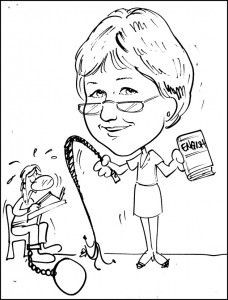
The Grammar Examiner taught high-school English for 40 years and was recognized by her citywide public school system as an outstanding ACT-prep instructor.
A tough-love drill sergeant in the classroom, she was affectionately known as “The Dragon Lady” by her students, who dared not call her by this name in person. Follow her on Twitter: @ExaminerGrammar