


Stupid Grammar, Spelling, and Syntax Mistakes You Didn’t Even Know You Were Making in Emails and Reports
Apostrophes, Homophones, and “I”
It’s a sad fact that people judge each other for superficial reasons. Despite what your high school English teacher may have told you, flawless writing isn’t the chief indicator of intelligence. But when you communicate with clients and colleagues mostly via email, text message, and written reports, they will evaluate your writing. And if your communications are rife with elementary errors, your peers will not be impressed.
Often, an email may be your only chance at a first impression. Why not make a good one?
Unfortunately, spell- and grammar-check don’t catch every mistake. Spell-check misses many homophone and apostrophe errors, and it certainly won’t catch that most embarrassing of gaffes: misspelling the client’s name.
Even if you’re just not a grammar guy, you can train yourself to see mistakes in your writing, just like you learned to observe the world with a keen investigator’s eye. Here are a few common errors to watch for:
The Apostrophe Agenda
I once had a senior in an advanced-level class who abused the apostrophe every time he used (or didn’t use) it. He was always wrong, a dubious 100 percent of the time. I privately suggested that he reverse his instinct in its use. This didn’t work, so I proceeded to construct a series of bell ringers (brief instruction with practice) on the use of the apostrophe.
When presented with a limited set of straightforward rules, my apostrophe abuser quickly became a punctuation pro.
You can easily rein in renegade apostrophes by following two simple rules:
Rule One: Always add apostrophe s when forming a singular possessive.
ex. the client’s retainer; Mr. Davis’s overdue bill
UNLESS THE POSSESSIVE NOUN IS A PLURAL (more than one) THAT ENDS IN S.
Which takes us to:
Rule Two: Add only an apostrophe after the s when the noun is a plural that ends in s (plural possessive).
ex. her parents’ car; the attorneys’ fees (more than one attorney)
*Please note that the rule does not specify any noun that ends in s—only plural nouns:
In summary:
Singular possessive: add ‘s — ex. an investigator’s billing system
Plural possessive ending in s: add ‘ — ex. all investigators’ billing practices; several days’ surveillance.
Singular possessive ending in s: add ‘s — Mr. Davis’s bounced check; Mavis’s big hair.
A clue: If you’re struggling with how to identify a possessive, keep in mind that it will often answer the question, “Whose”? There are a few confusing exceptions, notably a sentence like, “That job should take two days’ work.” Note that days’ in this case is both plural and possessive.
A possessive shows ownership. It’s an adjective, and you’ll usually find it before a noun OR after a noun in a sentence like this: “The problem is Jim’s.” (i.e. The problem is not an issue of too many Jims; the problem belongs to Jim.)
The Its — It’s Riddle
I have squandered an extraordinary amount of red ink on this issue alone. I’ll admit it: Misuse of these two wee words annoys me no end; and when I’m annoyed, I unleash the red pen. With abandon.
Here’s the single rule to remember:
DO NOT add an apostrophe to possessive personal pronouns (ex. his, my, their) unless they are in contractions.
Its is a possessive pronoun. Use it when you mean, “the thing belonging to it.” ex. The poor kitten! Its tail is injured.
It’s is a contraction for it is. Use it when you mean (duh) “it is.” ex: It’s time for a cocktail.
In order to avoid making an egregious its-it’s mistake, use this easy trick: When you are facing an its/it’s conundrum, substitute “it is” for the word you want. Say it aloud. If the two words fit, type “it’s.” If not, you want the possessive pronoun: its. Take 3 seconds to do this, and the error will magically disappear.
Remember this: An apostrophe in a contraction represents a missing letter(s). (ex. he’s = he is; I’d = I would) Knowing that can help prevent mistakes.
Fail to heed this simple step, and grammar examiners like me will narrow our eyes at your hapless error. We can’t help it. It’s who we are. We English nerds are everywhere, surveilling your correspondence, virtual red ink pen at the ready.
You have been warned.
The Your — You’re Contention
Use the same trick for determining your vs. you’re: Replace the word with you are and see whether it fits. If so, type “you’re.”
Your is a possessive personal pronoun. Use it when you mean, “the thing belonging to you.” ex. Your purple El Camino is not a good surveillance vehicle.
You’re is a contraction for you are. Use it when you mean (duh) “you are.” ex: You’re in big trouble.
Remember that:
- The form of the word should be the correct (intended) form before you add the apostrophe or apostrophe s. Form the singular – or the plural; then add the possessive.
- The purpose of punctuation marks is not to decorate but to punctuate. Don’t drape them willy-nilly all over your sentences like tinsel on a tree.

The Homophone Enigma
Speaking of your — you’re, let’s dig deeper into homophones, words that sound alike but have different spellings, the source of much angst…and frequent error.
Recently, I saw a cartoon of Snoopy embracing a distraught Woodstock and crooning a soothing, “Their, there, they’re” — (a cartoon clearly geared toward Grammar Examiner sensibilities).
These homophones are really easy to sort out:
The possessive personal pronoun their precedes a noun. ex. Their check bounced.
There tells where (note the similar spelling) and begins a “there” sentence. ex. There are consequences.
The contraction they’re represents they are—read it as such. Voila. Mnemonics can effect wonders. (Take note of that last verb.)
Careful pronunciation can help to clean up many errors, especially with such words as than and then, which are not truly homophones. Simply make sure that you can hear the a or e when pronouncing these words. Than signals a comparison; then tells when. (Please note again that similar spelling.)
ex. Mustangs are even worse surveillance cars than El Caminos.
ex. He got a retainer. Then he got to work.
Add into this category one of my husband’s sins: When he uses the past verb asked, he hears ask and spells accordingly. That clearly indicates mush-mouthed pronunciation. But then, he also suffers from selective deafness and a laissez faire attitude toward all things English-related. He also relies heavily on his in-house proofreader.
Most writers avoid misuse of homophones by simply following the caution: Be aware and take care. To, too, and two are easy; memorize them. Keep in mind that the adverb too tends to present the most problems. Just remember that too represents an extreme and has “too many o’s.”
Back to work! / I want to go home.
Too many breaks / Me too!
Surely you don’t need me to help you with two, too.
Not so easy are such words as affect (verb) and effect (usually a noun but in select instances can be a verb).
Examples: Weather affects my moods. (Verb—”to produce a change”)
Weather has a definite effect on my moods. (Noun—”a result”)
Weather effects a change in my moods. (Verb—”to cause or bring about a result)” Most people seldom use effect in this context.
When I learned to differentiate between these two, I also began to differentiate between the pronunciations (ah-fect, as in after, and eh-fect).
My best advice is to know your own failings and to:
1. Look up the word; or
2. Make use of a trusted proofreader.
You’ll find that you will probably need only one self-correction before your habits begin to change. Look it up once, and you’ll start to notice the error and fix it instinctively.

The “I” Issue
Number one on my all-time hit parade of dastardly mistakes is when people misuse the pronouns “I” and “me.”
I see this mistake most often when people use compounds. (ex. “just between you and I”; or even worse, “between he and I”) IT HURTS ME TO EVEN TYPE THESE.
These phrases should read “just between you and me” and “between him and me.”
However, this mistake is almost forgivable, as it signals a writer’s fervent desire to be correct. But even in its adorable, well-meaning wrongness, it’s problematic. To me, it falls on the ear with a particularly dull thud, the clatter of galloping pedantry — striving for the appearance of being right without actually going to the effort to be right. And at best, it reveals the speaker’s/writer’s ignorance of sentence structure.
Pronoun case in compound constructions*? (*translation: a phrase with “and/or” connecting the pronouns) Sooo easy to correct. Simply test the usage by:
1. dropping the other element in the compound (ex. If you wouldn’t say “for I,” don’t say “for you and I.”)
2. reversing the order of the two elements (between you and I; between me and you). The last allows you to hear a mistake (between I and you).
It always works.
NEVER try to evade a problem with I/me by substituting myself. Not only is that a lazy, obvious ploy to prevent mistakes, but it also creates a different mistake. (And it sounds pretentious, while still being wrong.)
Myself is either reflexive, reflecting back to another word: I made myself a he-man lunch.
OR
Myself is intensive, used for emphasis: I myself am responsible, no one else. I will do it myself.
The Capitalization Conundrum
Capitalization usually presents few problems for the average writer. Yet many an e-geek chooses to tweet, email, or blog, all in the lower case — sometimes even without punctuation, a la e e cummings. Since punctuation and capitalization are subtle reading clues, such slovenly practices make writing an obstacle course for the reader.
Hereafter, I will focus only on the few capitalization rules that often cause problems.
Common vs. Proper Nouns
Remember common and proper nouns from elementary school? Common (i.e. “university student”) requires no capitalization, but proper (i.e. “Harvard University”) is a specific name that requires it. A problem sometimes emerges when a specific name becomes so widely used that many perceive it otherwise.
ex. Any chamber of commerce, in general, isn’t capitalized, whereas the Omaha Chamber of Commerce, a specific institution, is.
I also see quite a few PI bios that look like this: “Bill Stevens is a Private Investigator, Bail Bondsman, and Owner of his own Private Investigations Company, Ace Investigations.”
There’s a whole lot of wrongness going on here. General categories and nouns like “private investigator” and “owner” should not be capitalized. Only the proper name—the company name—should be.
Here’s the correct (and unembarrassing) version: Bill Stevens is a private investigator, bail bondsman, and president of his own private investigations company, Ace Investigations.
Titles
Another common error is in multiple-word titles of any sort. The rule: Capitalize the following:
The first word
The last word
Any word between except prepositions (in, on, about, etc.); conjunctions (and, or, but, etc.); the words a, an, the. (ex. Ode: Intimations of Immortality from Recollections of Early Childhood)
Family Words
Capitalize family relations or titles used as a name or with a name, but don’t capitalize when referring to “my dad,” etc. (ex. Uncle George; I spoke to Mother; Her crazy uncle makes Thanksgiving a nightmare.)
Miscellaneous
Capitalize the names of directions only when they name a section of the country or the world (the Northeast, Southeast Asia), not when they are merely directions, like traveling east on I-70.
Do not capitalize the seasons of the year.
Capitalize any adjective that is a derivative of a proper noun. (ex. Chinese, Peruvian)
Note: Capitalize school subjects if they are languages (English, Latin) or names of courses, usually accompanied by a number (Geography 101, Algebra I).
SUMMARY
Remember that:
 1. e e cummings took poetic license, and “sir or madam, you are no e e cummings,” to paraphrase Lloyd Bentsen.
2. To quote one of my favorite college professors, one must know all the rules before breaking them intelligently.
3. Like tuning up an automobile, a little extra time and effort will smooth out your writing and have it clicking on all cylinders.
4. You want others to read your writing; communication and writing skills prevent distraction from the message.
Correcting your drafts requires:
- The desire to improve one’s writing.
- Being one’s own most severe critic.
- Reading critically and proofreading. Corrections present learning opportunities.
- Being aware of one’s failings and writing more carefully.
- Depending on your ear, and listening for errors.
- It also helps to let your rough draft get cold before proofreading, but that isn’t always an option when the email needs to go out right now.
I get it: We’re all busy people. It’s not always possible to do as thorough a proofread as we’d like.

One thing you can do is to perform a little triage on the writing your clients see. Making an error in a one-sentence text message can be explained away by thumb-typos and autocorrect. Emails are worth a little extra attention, especially if they’re formal, introductory, or contain important information.
However, I’d suggest devoting extra attention to report-writing, especially if you’re delivering a printed report. The final investigative report is a product, a calling card, and a great piece of marketing for you and your company—IF you can produce a well-written report, one that’s clear, to the point, and free of errors.
You’ll need to proofread a report several times. Consider getting fresh eyes involved in the process: ask a colleague or employee with good language skills to read the report. Have a dictionary or a Chicago Manual of Style on hand, even in virtual form. And whenever possible, take your time.
A Homework Assignment:

Hone your grammar examiner chops the same way I did: observe the language all around you with the same critical eye you apply to criminal malfeasance. Take the red pen to your surroundings. Error is everywhere, and often, it’s highly entertaining — church signs, restaurant marquees, menus, and all manner of earnestly hand-lettered directives in businesses, government offices, and (sadly) even schools.
For an especially good time, I recommend correcting restroom walls. Taggers and vandals should learn to spell those four-letter words before inflicting a double whammy on the rest of us.
For your amusement, here are a few favorite examples of time, effort, and expense wasted on egregious errors, emblazoned for all the world to see.
(See if you can spot the mistakes):
- Painstakingly embroidered on a pair of pillowslips: His and Her’s
- Painted on the window of a local used tire store: Credit Cards not Excepted.
- On a door in an area high school gym: Coache’s Office.
- Offered at a community college: Two-Week Coarse in Photography
- Posted on the door of a caterer: To rushed to cook for Thanksgiving? Let us cater your meal.
- Printed in a church bulletin: Kindness is it’s own reward.
- In a high school principal’s (not principle’s) email to faculty: Please send referrals to the assistant principals or I.
Show your work.
Do you have a question for The Grammar Examiner? Post it below, or tweet your question to @PursuitMag.
 About the Author:
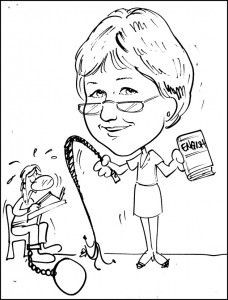
The Grammar Examiner taught high-school English for 40 years and was recognized by her citywide public school system as an outstanding ACT-prep instructor.
A tough-love drill sergeant in the classroom, she was affectionately known as “The Dragon Lady” by her students, who dared not call her by this name in person.