

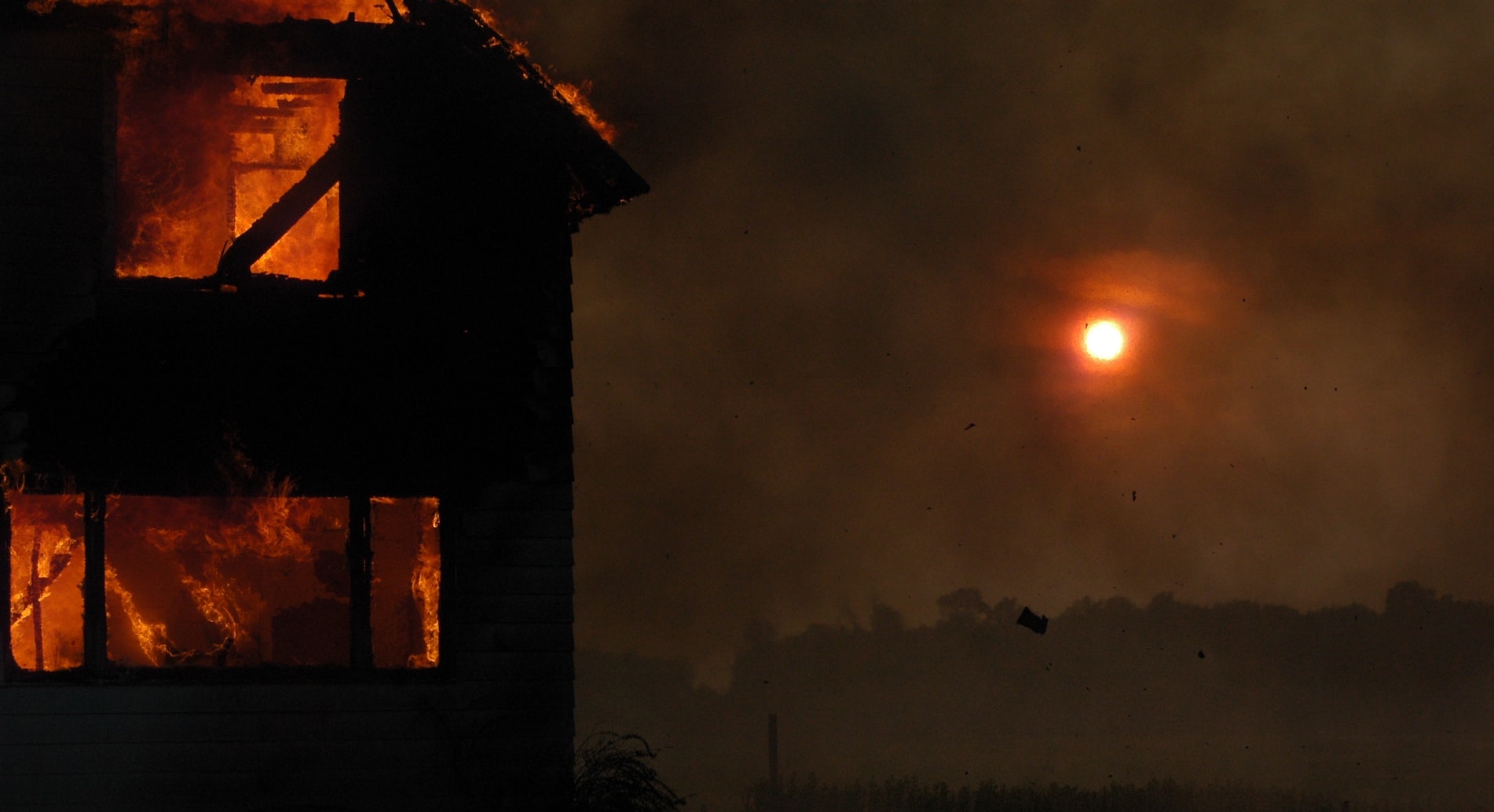

Tradecraft Tips: A private investigator with over four decades of experience in fire service explains his investigative process and the necessary mindset for anyone in forensics.
First, learn how things burn. Stuart Bayne, an investigator and fire expert known as The Fire P.I., started his fire education right out of college, “with no clue what to do,” he says, grinning. “I stepped into the fire department because they had big red, shiny trucks and I needed to learn how to work with my hands.” His early career as a firefighter, teacher, and insurance investigator taught him how materials combust, how fires spread, and how to find evidence of arson.
Then he had to unlearn some things.
Fire Myths
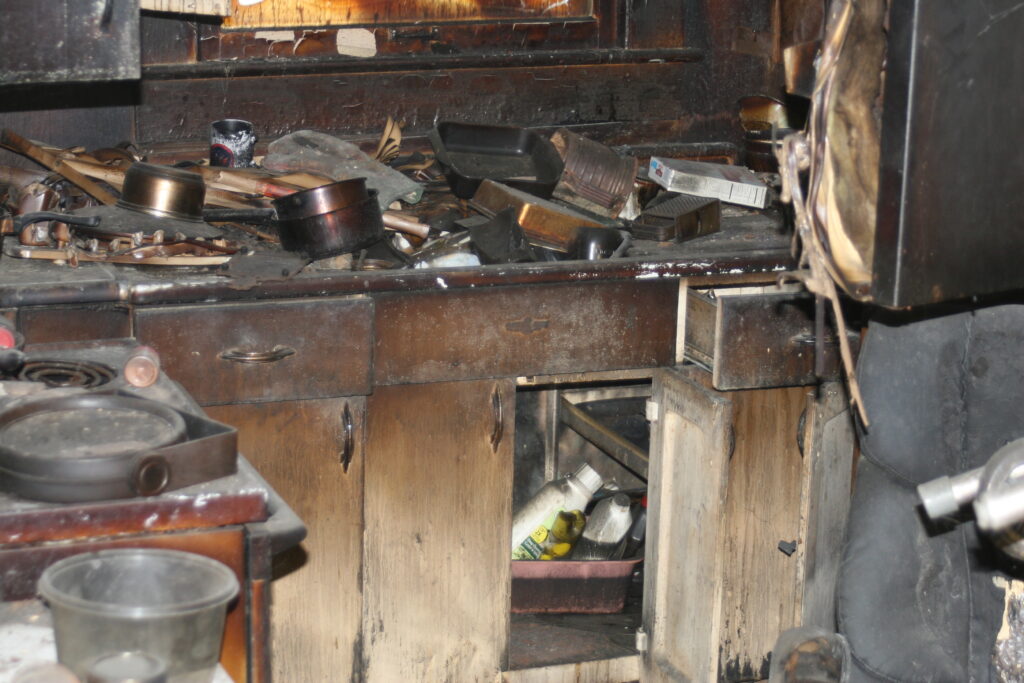
Forget what you think you know about arson and explosion investigation. Many signs of arson that investigators and courts have long accepted as hard evidence have more recently been proven wrong. After the Oakland Firestorm of 1991, researchers studied hundreds of structures destroyed by the wildfire and found something they didn’t expect to see: glass crazing (tiny, weblike fractures), “alligatoring” (blistered wood), molten metal, and concrete spalling (surface chipping). For decades, fire investigators had interpreted these as indicators that accelerants had been used. But this fire was accidental.

“So there are a lot of myths,” Bayne acknowledges. Another fallacy he warns against — which had become common practice in the field — is drawing a conclusion of arson when no evidence of accidental fire could be found. “We ruled out electricity, we ruled out candles,” says Bayne, ticking off a long list of possible causes. “And we could not find that ignition source … Therefore, I may jump to the idea that well, there’s no ignition source here because the guy came in, lit the house, and left and took it with him.” In the fire world, this method of proving arson by eliminating possible accidental ignition sources is known as “negative corpus methodology.” (Derived from corpus delicti, a legal term meaning “concrete evidence of a crime.”)
That faulty reasoning (along with other flawed techniques and erroneous indicators) was repudiated by a report that came out in the wake of the Oakland Firestorm arson study: The National Fire Protection Association convened a group of experts to create more rigorous guidelines for fire investigators; in 1992, they issued the NFPA 921: Guide for Fire and Explosion Investigations, a landmark document that sought to replace fire investigation mythology and reliance on instinct with the scientific method.
Some in the law enforcement and fire science community fiercely resisted the NFPA 921 guidelines, says Bayne. But he considers it his fire investigator’s bible. “My approach to the fire scene investigations always begins with an adherence to this document and to the scientific method,” he says.
Always a Student
Study that document. Don’t blindly accept the old conventional wisdom. Crazed glass, V-shaped fire patterns, sagging furniture springs, pour patterns, and melted plumbing may not necessarily indicate the presence of accelerants. Trained dogs sometimes sniff out accelerants that aren’t really there. Don’t think of indicators like these as evidence; think of them as starting points for further investigation — all of which should be verified by some other means, such as lab testing or witness interviews. Most of all, reject the “negative corpus” model of reasoning. The absence of evidence doesn’t constitute proof of a crime.
Without a clear picture of what occurred, it’s easy to jump to conclusions. Be wary of confirmation bias. To illustrate, Bayne outlines a hypothetical investigation: A fire late at night, an absent homeowner with a criminal record. “I’m already suspicious that this guy set this house on fire, and so I’m going to work toward confirming that,” says Bayne. “I might miss a piece of evidence … because he ‘had to [have done] it.'”
Once you start generating preconceived notions rather than relying on the evidence, you might overlook or dismiss relevant data in favor of proving yourself right. Let the facts inform your conclusions; not the other way around.
Let the facts inform your conclusions; not the other way around.
After nearly five decades of watching his profession evolve, Bayne fully grasps the consequences of all those years of junk arson science in his field: innocent people sent to prison, families bankrupted by denied insurance payouts, and generations of judicial precedent that admitted unreliable evidence and testimony in court. He strives to counter the myths and deliver factual results that are based on proven techniques. The NFPA 921 Guide is, for him, merely a starting point; staying up-to-date as a fire investigator requires a flexible mindset and intellectual humility. “Have the willingness to be wrong and the courage to test your origin and cause hypothesis,” he says.
Constantly seek new information about your field; stay curious and open to new forensic developments. “60s, a student. 70s, a student. 80s, a student. 90s, a student,” Bayne says of himself. “See where this is going? You’ll always be a student.”
The Investigation
A fire investigation can take several forms: you might go to the scene of the crime, look at floor plans, interview witnesses, or study sample results. Sometimes you won’t even get a fire scene to look at if the case is years old; you must glean data from a case file and photographs. “My function is to determine, if at all possible, an origin,” Bayne says. “Then, we step into cause. What could have caused the fire to occur in that area of origin or that room of origin? And so, we’ve got to rule out all the ignition sources we can find.” Examine all possible scenarios and available evidence to determine what happened: was something left plugged in? Did something accidentally catch fire? Or was the fire intentionally set?
In considering these questions, don’t rely entirely on anecdotal experience — or your gut. Collect evidence, form a hypothesis, and test your hypothesis to prove or disprove it. Can you reproduce the patterns you’re seeing with a test burn? What does a lab test tell you?
When coming up with his final conclusion, Bayne likes to describe his results as “technically defensible.” For Bayne, that means, “I have found an answer, and it is defensible not just by me, but by facts. Not just because I said so, but because fact, one, two, three, assumption, one, two, three, and four.” With forensics, everything comes back to the facts and the science. If you have to testify, you are likely the only person in the room who understands fire science to a professional degree and can ascertain what happened; jurors and the judge don’t have the same education that you do. It’s your duty to be as fact-driven as possible. Never overstate your certainty or your expertise, especially when testifying.
“It’s a long hill up, up, up to right a wrong.”
Stuart Bayne
You’ll have several cases in varying stages simultaneously, with some cases taking many months to solve. For Bayne, the work “has been predominantly criminal defense,” taking cases from public defenders and working with criminal defense lawyers. But throughout a career as a fire investigator, you may also end up working for insurance companies or the Department of Energy.
You may also be called to work upon a different sort of case: reinvestigating on behalf of the wrongly accused.
Righting Wrongs
Steel yourself for a tough road. These cases can often be the most difficult, but also the most satisfying. “It’s a long hill up, up, up to right a wrong,” he says. One egregious wrong was made right last year, thanks in part to Bayne’s testimony and advocacy: After serving nearly 30 years for an arson-murder he did not commit, Claude Garrett walked free from a Tennessee prison in May of 2022. For years, Bayne had been telling judges, prosecutors, and the Davidson County DA’s Conviction Review Unit that the evidence used to convict Garrett was now widely understood to be junk science. Finally, the courts listened.
Seeing Garrett walk free was one of the highlights of Bayne’s long, varied career. He still reflects on a gift he received from Garrett’s daughter, Deana Watson: It was a book “about how her life was changed, and her son’s life was changed because there were a few people who bothered to get it right,” he recalls.
“Seeing a pursuit come to fruition and result in this kind of love … that’s incredible. It stirs. This is why we do this.”
About the author:
Sarah Datta is a writer from San Diego, CA.
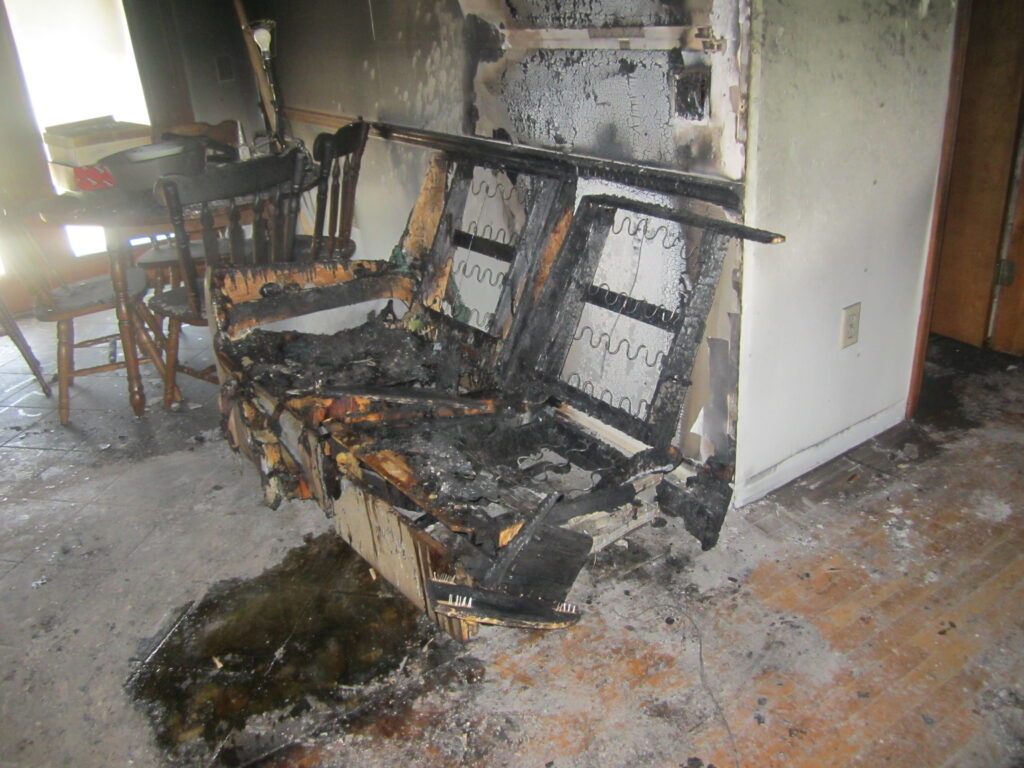
sidebar: “The love seat (above) was incorrectly positioned (and shown with its back) against the wall by the authorities, who decided it was set on fire by the homeowner. The love seat was actually positioned with its end against the wall; an electrical outlet on the wall against the end of the love seat (in which a light fixture was plugged) overheated, causing the love seat fabric to ignite. You will see the overall direction of fire progression from right to left as you face the love seat.” —Stuart Bayne