



Want to scam somebody on LinkedIn? Maybe don’t ask to connect to a Certified Fraud Examiner.
From time to time you see them: Profiles on LinkedIn (or other platforms) that are obviously not real. But sometimes, it’s harder to tell fact from fiction.
I recently got a request from an account with whom I shared 28 connections. Sounds legit, right? Far from it, as it turns out.
Pro tip: Before trying to connect your profile to someone, see if maybe they are a CFE, which stands for Certified FRAUD Examiner.
I’m not sure what it was that first tipped me off that there was something just off about this profile, but there was a certain JDLR about it. JDLR, for those not fortunate enough to have been schooled the hilarious wisdom of Abe Martin, stands for Just Doesn’t Look Right.
So before I go reporting it to LinkedIn, I thought I would do some checking on some of the potential red flags. What are those red flags? Let’s run through them:
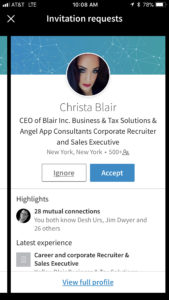 1. The business: Is it legit?
Nope. Neither Oregon nor New York have a business registered with any permutation of the name “Blair Inc. Business & Tax Solutions.”
2. How about the secondary business, “Angel App Consulting”?
Nope, sorry. Not registered in Oregon, and the biggest of all the huge red flags on the fresh-out-of-the-box company site? The contact information! Which is listed as, no joke: “Lexus 123 Main st. NYC, CA, 90333, U.S.A Telephone: (035) 757-3321 / Fax: 12345612390” And the Facebook page is just posts of some game called “Coinbird.”
3. How about the credentials for the principals listed?
Nope there, too. There is no one by either of these names registered with either Oregon or New York’s state agencies that license tax professionals.
4. So, let’s try to reach this person by phone.
Maybe they just need to get their business filings in order. If they are soliciting my business, I’m sure they’d like an opportunity to tell me about their professional affiliations and such. Well, nope again. The number on the web site goes to a generic voicemail and snappy hold music, then a recording saying “the number you’ve reached has not been assigned,” then you’re disconnected.
5. Well, maybe this person is just in transition.
Let’s ask my connections who are also connected to her. Twenty-eight people means there’s a fair degree of overlap. Nopety nope nope. None of the folks I asked had ever actually worked with this person, or knew who she was, or what the business was.
6. OK, so who is this person really?
Is there a such a person at all? Well, they say they went to Willamette for law school. All the Nopes. If they did, they couldn’t have gotten that Associate’s degree they are advertising themselves as getting. Willamette confirmed for me they don’t actually award Associate’s degrees!
I don’t know if there’s really a person named Christa behind this account, trying to make her way into our networks with fakery, or if it’s some sort of content-generation scheme designed to harvest intelligence from unwitting folks who are open to connecting with whomever asks. But in the end, it doesn’t really matter. For me, it was just a reminder to always look beneath the surface and maintain some healthy skepticism on social media.
 About the author:
Eli Rosenblatt is an investigator, professional trainer, and digital forensics specialist in Portland, Oregon. His caseload includes in-depth background investigations, social media, comprehensive workplace investigations, missing persons, criminal defense, civil, insurance, and family law. Eli is a Certified Fraud Examiner, Certified Forensic Interviewer, Social Media Intelligence Analyst, Certified Internet Research Specialist, and Board-Certified Criminal Defense Investigator.