



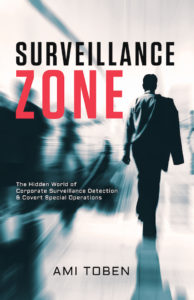
This article was excerpted from Ami Toben’s new book, Surveillance Zone: The Hidden World of Corporate Surveillance Detection & Covert Special Operations.
by Ami Toben
It was still dark outside when the first undercover operative arrived at the Palace Hotel in San Francisco. A thick layer of fog swirled through the streets as the operative made his way into the lobby. He sat down to wait for his partner, and for the man who had hired them for the job. The hotel was to be the site of a large tech conference that day, and the two operatives had to be in position fast. Conference attendees would soon be streaming in for registration, and before long, the guest speakers would begin to arrive—including one specific Silicon Valley billionaire they would be watching for.
As the hubbub in the lobby built to a crescendo, the operatives slid into the background. It was imperative for their mission that no one knew who they were or what they were doing there.
While this might sound like a nefarious plot in some Hollywood movie, this was actually a covert protective operation, and part of a whole undercover world that very few people know exists—an invisible world I call the “surveillance zone.”
Introducing the “Surveillance Zone”
Let me offer you a peek behind the curtain—and into the “zone.” That first undercover operative mentioned above? That was actually me, and the man who had hired us was the senior security director for a well-known Silicon Valley corporation. We’d been hired to covertly protect the billionaire founder and CEO, whose company—despite some dramatic downswings and falling stock prices—was about to unveil a new venture. The mix of angry stockholders, excited techies, and nervous investors had company execs feeling skittish and us on our guard, and made for a tricky and interesting assignment.
On top of all that, the CEO had been receiving increasingly violent threats from a dedicated stalker who had demonstrated the will and ability to take things to the next level. Having surveilled the CEO’s home and workplace, and even physically confronted the CEO, there was ample reason to take the stalker’s intentions seriously.
When the threat to harm the CEO at the convention had come in (just a day before the event), the company decided to take action. At ten pm, I received a call from the security director, requesting our presence at the hotel at six am the following morning.
Providing “impossible” solutions for last-minute requests is a typical part of the crazy undercover world I live in. The CEO would have a covert security bubble around him the entire day. No one could know about it, because one post about him employing high-level security would’ve been enough to cause a sensation, which might spook potential investors. The company needed a low-drama event, and it was our job to keep it that way.
In order to maintain the illusion of normality, we were about to transform ourselves into tech conference attendees, hotel guests, maintenance workers, and personal assistants. We’d need to spread out and blend in—sitting in the front row of the lecture hall, standing backstage, waiting at the hotel entrance, hanging out in the alley outside the hotel, and running up and down dark emergency staircases.
I’d been in plenty of thorny covert operations before, but this one was going to be a challenge.
Private Security: What It Is and How It Works
Let’s take a step back: What exactly is this line of work, and how much of it really takes place? How does it even work? Are we the “bad guys” who do the bidding of dark corporate interests?
The story above is but a single example of the types of covert protective operations that take place every day in the private security sector. Most people don’t even realize this field exists. (In an industry of quiet professionals, it’s considered bad form to talk too much.)
And yet, it certainly does exist, and it’s only getting bigger.
Close your eyes and imagine what kind of physical security the top 50 corporations on the Fortune 500 list have, and what kind of protection their top executives receive. Many people assume that these people must live in a bubble of high-tech, James-Bond-villain security. Hollywood has definitely done its part in perpetuating this notion. But mostly, the reality would both disappoint you and completely blow your mind.
I say “disappointing” only in reference to Hollywood’s glamorized depictions. In reality, it’s actually kind of reassuring to discover that many famous and influential people lead largely normal lives. Plenty of multi-billionaire-CEOs regularly drop their kids off at school, get their coffee at Starbucks, and go home to their families at the end of the day, just like everyone else. And I’ve found that most of the CEOs I’ve worked for value that normalcy, and thus, are extremely reluctant to agree to security measures.
To further complicate matters, security protocols within an organization—or in the life of an executive—may often appear disjointed or inconsistent. For example, some corporate facilities have areas where outsiders can easily talk themselves into an office area right next to other areas with Mission Impossible-style security. Some tech moguls who go unprotected to their kids’ school plays may, at other times, be surrounded by covert protection that exceeds most people’s assumptions about what a James Bond villain would have.
If you see a paradox in any of this, then let me officially welcome you to the world of high-end protective operations.
Truth and Fiction
Anytime you’re dealing with covert security operations, people will come up with some pretty wild and imaginative ideas about it. So let me address a few of the common misconceptions that I’ve heard over the years.
 1. There is nothing sinister about the high-level security that multinational corporations and billionaire executives receive.
As private security professionals, it’s our job to protect our clients and their companies. Many people might think that the CEOs of major corporations are somehow impervious to threats as they sit in their well-secured fortresses. But I can tell you from experience that threats of physical harm (which are far from rare) affect them pretty much the same way they affect anyone else.
Think whatever you want about the “lifestyles of the rich and famous.” These people have homes and families, and they worry about their loved ones just like the rest of us do. Those of us who work in private security are simply there to keep them safe.
2. Security operations do not put unwitting bystanders in danger.
The security of our clients doesn’t require putting anyone else at risk. If anything, it’s just the opposite: The best way to protect our clients is to ensure that the entire area is safe and secure—for everyone.
“But what about cases where someone wants to harm your client?” you might ask. Again, the best way to protect the client is either to avoid the area altogether or to prevent those who want to do harm from taking action. On many occasions, I’ve had to jump in between clients and those who were trying to harm or harass them.
Harming those who want to harm our clients is an absolute last resort—and an extremely rare one. In almost every case, the goal is to make sure that no one gets hurt on either side.
3. We are not supervillains with nefarious agendas.
The vast majority of operators in this industry are honest, moral people. Most of us are military veterans, former or current law enforcement officers, firefighters, paramedics, and former government agents. Working in dark suits or operating covertly doesn’t mean you are up to no good.
Like in every industry, we get the occasional bad apple. But those types get flushed out very quickly. Mean-spirited or overly-aggressive people simply don’t do well in a high-level security environment.
Mission Accomplished
And now, back to that beleaguered Silicon-Valley CEO and our tech-conference mission: That morning, we conducted a quick but thorough advance walk-through of the event space—including conference area, main stage, private meeting rooms, and exterior of the building.
As the tech conference chugged along, we took various positions around the CEO, then covertly escorted him to a private meeting room, one floor up, after his speech ended. As the meeting dragged on later than planned, we found ourselves with a dilemma: The schedule change meant that the exit route we’d planned would now need to change, too. By then, the convention area was packed with 2,000 techies—many of whom were waiting for the CEO with questions, pitches, and what have you. And now that the twitterverse had been thoroughly updated about the CEO’s presence at the conference, there was an increased chance that the CEO’s stalker would also make an appearance.
“We have to get him out fast,” instructed the security director, “and I can’t have him go down through that crowd.”
A quick change of plan was in order. We decided to have the close protection operator escort the CEO to an emergency exit at the end of the upstairs corridor. From there, they would hurry down the dark staircase and out into the alley where the vehicle was waiting.
We had covered this emergency exit route during our morning walk-through. Realizing that we’d now need to use it, I quickly walked the route again—about two minutes before the CEO. When I got to the alley, I instructed the waiting driver to back up the vehicle so it was flush with the emergency door.
Within moments, the CEO was being driven away—leaving 2,000 attendees to wonder how he had simply vanished. It was an unexciting end to a tense day. But “unexciting” was exactly what we’d planned for.
About the author:
 Ami Toben is the director of consulting, training and special operations for HighCom Security Services and the owner of the Protection Circle blog. He is one of the pioneer developers of the terrorist activity prevention, surveillance detection, and covert protection fields in Silicon Valley.
Trained in Israel, Japan and the United States, Ami has over 15 years of military (IDF) and private sector security experience. Based in the San Francisco Bay Area, Ami provides special protective services to Fortune 500 corporations, foreign governments, foundations, political organizations and wealthy individuals.
His new book about private-sector espionage, surveillance detection, and covert protective operations has come out on June 5th. You can buy Surveillance Zone at Amazon, Apple iBooks, or Barnes & Noble.