



M. Chris Fabricant, an Innocence Project attorney, has written a damning indictment of how bite mark evidence and other debunked forensic techniques persist in American courts.
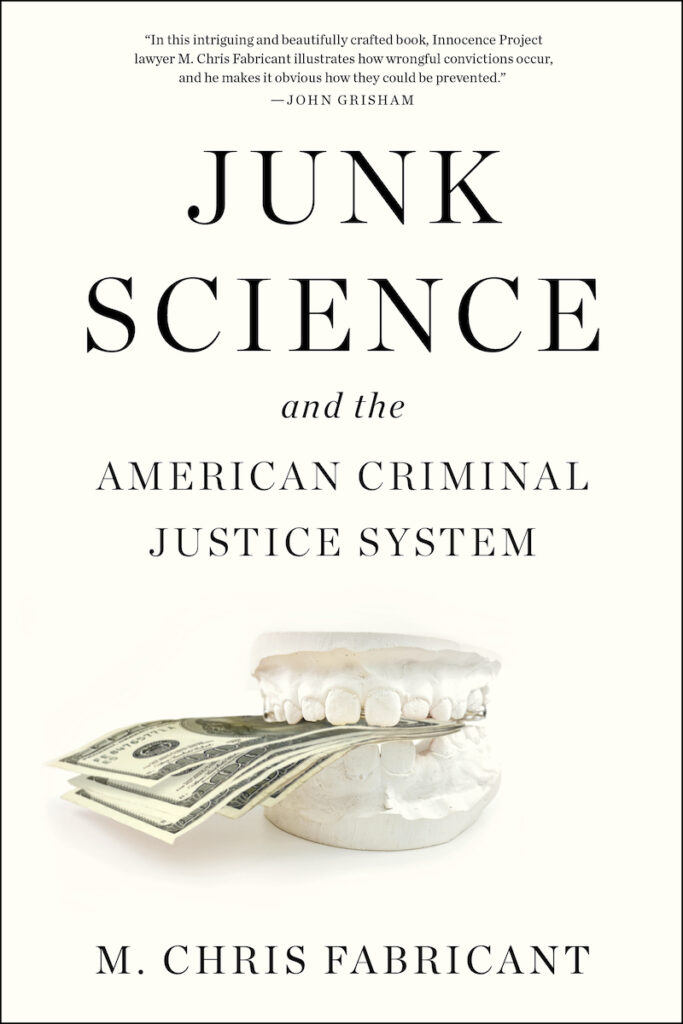
Junk Science and the American Criminal Justice System
By M. Chris Fabricant. Akashic Books. 368 pages. Hardcover $29.95.
In the opening pages of Junk Science and the American Criminal Justice System, M. Chris Fabricant sets a scene of horror: In Newport News, Virginia, on a summer night in 1982, Teresa Perron tucked her children into bed, then woke later to a sinister thumping sound; a man in a naval uniform had broken in and struck Teresa’s husband fatally with a crowbar. The intruder then attacked her, raping her several times and biting her thighs.
Teresa never got a good look at her assailant, but police used her description of his uniform to home in on a long list of suspects: enlisted men from an aircraft carrier dry-docked at a nearby naval base. With few other leads, investigators called in dentists to compare the dental records of 1,300 sailors to photographs of the bite marks on Teresa’s thighs. Police soon focused on Keith Allen Harward, a sailor arrested on an unrelated domestic violence charge, but there was no evidence linking Harward to the crime; he even had an alibi. Determined to build a case, they turned to a relatively new forensic science: bite mark analysis.
Eventually, Harward was convicted of rape and murder, based on the testimony of bite mark experts, who matched molds of Harward’s teeth to the bruises on Teresa’s legs. The Newport News community exhaled with relief — a vicious killer was off the streets. Science had saved the day.
The catch? Harward was innocent.
Fabricant’s book weaves the cases of Harwood and two other men wrongfully convicted based on bite mark analysis — Steven Mark Chaney and Eddie Howard — into the wider story of how bite mark evidence came to be accepted in courts. That story begins with People v. Marx (1975), the first case to admit bite-mark evidence, even as the judges conceded that there was “no established science of identifying persons from bite marks.” They were essentially admitting that bite mark analysis didn’t pass the Frye test, a legal standard set in the 1920s requiring that for forensic evidence to be admissible, it must be “generally accepted” in the scientific community. The People v. Marx court circumvented the Frye test by inventing its own specious standard of evaluating forensic evidence based on judges’ and jurors’ common-sense observations — the “eyeball test.”
People v. Marx and the “eyeball test” set a dangerous precedent, opening the floodgates for courts to admit bite mark evidence, an untested discipline with no foundation in the scientific method. “The only thing standing between the use of ‘scientific’ evidence and a jury is a judge,” Fabricant explains. “The judge, however, will almost certainly rely on legal precedent — not science — to make a decision.”
At its core, Junk Science and the American Criminal Justice System is a transfixing and often horrifying journey through what that precedent has wrought in criminal courts and in the lives of innocent defendants. The combined effect of the history-oriented chapters and the intimacy of the three case narratives is compelling: Fabricant never lets us forget that every misstep of the justice system has a name and a face attached to it.
In a broader sense, Fabricant’s book is a damning exposé of how forensic science is used (and misused) in the American criminal justice system. His expertise as an Innocence Project attorney shines through on every page, as he illuminates where individuals and institutions went wrong in the cases he examines. Readers will come away with the unsettling realization that many forensics techniques are supremely unreliable, with bite mark analysis being one of the most subjective. “Because healing and decomposition are dynamic processes, there is no accurate way to take these uncertainties into account,” Fabricant writes, “and because skin changes over time, teeth may appear to ‘match’ one day and not the next.”
The book calls for systemic change, implores us to be more curious about the legal institutions we take for granted, and raises questions that should have been addressed long ago in the criminal justice system: Law and science are inherently different, so why do judges decide on what evidence to include? Why aren’t there more rules surrounding forensics science? Why hasn’t the government taken a bigger role in ensuring that the techniques used to send citizens to jail are actually sound?
Fabricant ends the book with a glimmer of hope by including some of his own experiences reversing wrongful convictions, proving that sometimes the wrongs of the justice system can be made right. But the question remains: How can we prevent those wrongs from happening in the first place?
M. Chris Fabricant answered questions from Pursuit about his experiences working for the Innocence Project and writing his book. This interview has been edited for length and clarity.
SARAH DATTA: Throughout your book, you talk about the differences between science and law. What has it been like for you, as a lawyer, to have to become scientifically literate? When you do cases like DNA exoneration, for example.

CHRIS FABRICANT: I was not a science major in undergrad, and I didn’t come to the Innocence Project with a background in science. I really spent the first couple of years here at the Innocence Project learning about science, scientific evidence, scientific method, and statistics. I was really, really fortunate in that I had some of the brightest scientists that are interested in justice and in forensic sciences in particular, as tutors. So, I had to audit a stats class with Dr. Karen Kafadar, who’s the head of Statistics at the University of Virginia. among many other titles that she holds. It was a daunting learning curve to become even conversant in the language of science. If you’re working in the arts, it is a challenge.
Really, the world opened up to me in the same way that law school does. You have a new understanding about the way the world works. If you don’t have any background in science, you don’t really have an appreciation or critical thinking skills around scientific claims. And when I learned all this, I was just kind of aghast at some of the lawyering decisions that I had made earlier in my career as a baby public defender because I didn’t know about some of the failings of forensics and some of the challenges that were available. So I’ve looked back on pleas I took and hair microscopy cases and some of the other techniques and shudder to think.
DATTA: Is there something that you wish more people and jurors knew about forensic science? Nowadays, movie and TV depictions of forensic science are really commonplace, so do you think that’s helped or hurt jurors’ understanding of forensics?
FABRICANT: Shows like CSI have been really detrimental to public understanding of the limitations of forensic sciences. In shows like CSI, the forensics are presented as infallible, quick, conclusive, you always get the bad guy. The good guys are always the forensic experts. That’s just not the way the world works, and that’s not the way that science works. What we know from social science research is that when scientists or expert witnesses are speaking, we tend to turn off our critical thinking skills and defer to expertise. There isn’t any incentive to be skeptical about the claims made on a witness stand by somebody wearing a white lab coat. But faulty forensics have led to more than half of all known wrongful convictions proven by DNA evidence.
Scientific illiteracy is widespread in the United States. Generally, that’s a problem. It’s popular culture that perpetuates the myth of infallibility of forensics and lack of skepticism in lay jurors when those claims are made in court. One of the reasons that I wrote the book was to try to change this false narrative around the use of forensic science. As you know, you can call it UNtrue crime.
When scientists or expert witnesses are speaking, we tend to turn off our critical thinking skills and defer to expertise. There isn’t any incentive to be skeptical about the claims made on a witness stand by somebody wearing a white lab coat.
DATTA: One scene that really stuck with me was the AAFS scientific meeting: you’re in front of all these dentists who still believe in bite mark analysis, and you’re pointing out these logical fallacies and wrongful convictions. How do you have that courage to keep showing up and addressing these fallacies when so many people are out to dismiss you?
FABRICANT: I was a longtime public defender before I came to the Innocence Project. So I’m used to wearing the black hat, and I don’t mind not being popular. Certainly in the forensic dentistry crowd, I’m not very popular. But I really, truly believe in engaging our adversaries or people with whom we disagree.
One of the real benefits of science is that good science is objective, right? The few times that I’ve been able to persuade dentists to renounce bite-mark evidence, we were in calm settings — in people’s homes, at a restaurant — talking about the fundamental assumptions underlying bite mark evidence. If we were in court, and I was cross-examining, here’s a question that I would ask you:
[Fabricant] “How is it that you can be certain that when you identify an injury as a bite mark that it is, in fact, a bite mark?”
[The possible response from a dentist] “Well, I’ve seen so many.”
[Fabricant] “How do you know all those that you looked at were bite marks? Really, you weren’t there, right? And we don’t have an objective definition or threshold for defining a bite mark.”
In court, it’s adversarial. But if you have those types of conversations outside of the adversarial system, you can make some progress. The problem often is (borrowing a line that I read in the New York Times) when you mix science and politics, what you get is politics. That’s why the politicalization of forensic sciences, particularly after the 2009 National Academy of Sciences report, has resulted in denialism and an entrenchment of previously held beliefs. That’s part of how the human mind works, and that debate and that struggle continues today, so it can be very, very frustrating.
At the same time, I have the best job in the criminal legal system. I enjoy the struggle. I have an inherently political job, and if you’re working in an area that you’re passionate about, nothing better.
DATTA: Who still has a stake in keeping things as they are? Who are the groups you and your colleagues at the Innocence Project have identified as still resisting this effort to reform forensic science?
FABRICANT: Prosecutors. Law enforcement, prosecutors, and politicians. The truth is that the law-and-order rhetoric is still so strong, and so many campaigns are run on fear of crime. We have this happen here in New York with [State Senator Tom] O’Mara. O’Mara was whipping up hysteria around street crime that was leveraged in Long Island and turned elections on this. You don’t win elections by saying, “We need to rethink the way we’re approaching our criminal legal system and our policing efforts!” In other words, to make the system more fair, or less punitive, and a more problem-solving approach — that just doesn’t win elections. So resistance to change, and denialism around the impact that junk science has in criminal trials, is just rampant, and it costs lives. Literally.
DATTA: What do you see as a path forward for forensic science? What kind of changes are you hoping to see?
FABRICANT: I would love to see something like the FDA for forensics. We have the FDA because we care about the safety of consumer products that Americans use. Right? We have nothing like that in forensics. The only thing standing between you and a junk science conviction is a judge, and a judge is very likely not to consult the scientific literature when he or she is deciding to admit evidence. They’re going to consult case law.
Every form of junk science that’s been totally rejected by the scientific community is still in the law, considered good, admissible evidence. That is fundamental to this problem. What we need is something like the FDA for forensics that will do validation research before it’s involved in the adversarial system, because the adversarial system takes facts and bends them to the will of the advocates in the courtroom. That’s a terrible place to search for scientific truth or to debate the merits of a particular forensic technique. We care more about the safety of toothpaste and aspirin than we do about the forensics that are used to decide life and liberty issues, and which disproportionately harm Black and Brown people in this country.
DATTA: Is there anything else you want to highlight from the book or talk a little bit more about?
FABRICANT: One of the things, because this is a piece for Pursuit Magazine, is the role that confirmation bias plays in investigations, and in particular, in the three clients’ stories that I focus on in my book — Eddie Lee Howard, Steven Mark Chaney and Keith Harward. All of the detectives in those three separate cases allowed their own biases to sway the way that they were investigating the case and to allow one piece of evidence to misdirect an entire investigation, to focus on an innocent person. This is a fundamental product of human decision-making; I’m not pointing fingers at them.
Once a suspect has been identified by police investigators, forensics are used to paint a bull’s-eye around that target. It is really the police investigation that is the triggering event to so many of these wrongful convictions. It’s not the forensics themselves.
FABRICANT: In an investigation, avoiding tunnel vision is so crucial in preventing wrongful conviction. It’s so important to have multiple investigators following different paths on investigations and not to rely on a forensic match to anchor an investigation, because it may not be reliable. What we see in a lot of the cases that I talked about in the book is that once a suspect has been identified by police investigators, forensics are used to paint a bull’s-eye around that target. It is really the police investigation that is the triggering event to so many of these wrongful convictions. It’s not the forensics themselves. We didn’t find bodies in fields and say, “Hey, here’s a bite mark, can we put this in a national database and look for the teeth that made this bite-mark?” That didn’t happen. What happened was “Is that a suspect in the case?” I write about an innocent suspect that was identified, and then, “Oh, that’s a bite mark!” And then they match those teeth to the bite-mark. So, it really begins with a biased investigation.
About the author:
Sarah Datta is a writer from San Diego, CA.
M. Chris Fabricant is the Innocence Project’s Director of Strategic Litigation and one of the nation’s leading experts on forensic sciences and the criminal justice system. Fabricant is featured in the Netflix documentary “The Innocence Files,” and his public commentary has been published in virtually every major media outlet. A former public defender and clinical law professor, Fabricant brings to his writing over two decades of experience ranging from litigating death penalty cases in the Deep South to misdemeanors in the South Bronx. Born in New York City and raised in Sedona, Arizona, Fabricant has lived in Brooklyn since graduating from George Washington University Law School in 1997.