

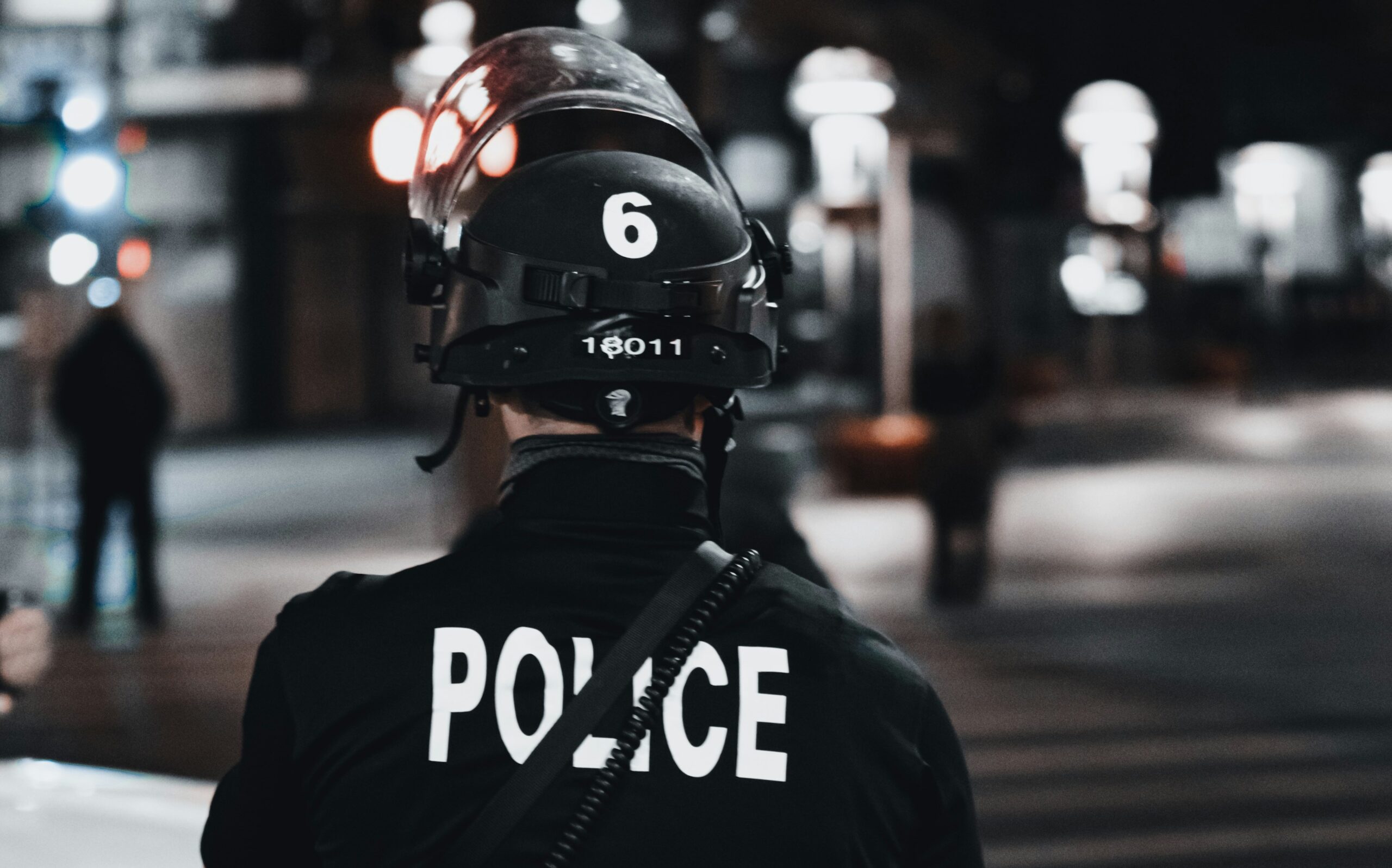

Some habits formed on the force have to change in the private sector. Others stick with you forever.
Even when you do everything right, sometimes things can still go south rapidly. You can end up fighting for your life in the blink of an eye.
I was a brand-new cop (two months on the job). My partner had been on the job for one month. Late one night, we got a domestic disturbance call.
We parked two houses away and assessed the scene. A stereo was blasting from the house. The front door stood wide open. We spoke to some neighbors gathered outside, looking rattled.
A hulking figure had by then emerged and was standing, backlit, on his front porch. We called to him — no response. We were swathed in the darkness of the street. With that and the stereo noise, he probably had no idea we were there.
He turned and went inside. We followed, still calling out to him. We were in full uniform. The stereo was deafening; I couldn’t hear my partner right beside me. As I stepped across the threshold, the guy turned, scooped up a pistol from the back of a sofa, and brought it around level with my face. He was almost close enough to touch.
It was game on.
I won’t bore you with the details, but it was messy and painful (mostly for him), and we won. He was lucky we weren’t armed, because I have no doubt that one or both of us would have shot him.
It was a good lesson to learn early in my career: You can do everything right, and things will still go wrong.
That was a frontal assault, so we could see it unfolding and react appropriately. But there’s a reason why fighter pilots like to attack from behind and come out of the sun. It’s harder to detect and harder to defend against. Assailants are the same — it’s much better to give someone a cheap shot when they’re not looking than go toe to toe.
I’m far less likely now to face an assailant. Since joining the ranks of private investigators, the bulk of my work has been criminal defense. It’s not my job to arrest anyone. I’m just there to ask people questions.
Still, I’m going into the same neighborhoods I did as a cop. Talking to the same people. I know that I look the same. I walk the walk and talk the talk; it’s hard to shake after a lifetime of doing it.
But those attitudes won’t help me do my job on the street.
While situational awareness still serves me well, there are some other habits I’ve had to change since leaving the police, such as:
What I Drive and How I Dress
Rolling up to a house, in a marked car and a uniform, straight away you draw attention to yourself. Even as a detective you know that you stand out. And dogs are just as much of a threat as people. I think I pepper sprayed more animals than humans in my career.
As a private investigator, I dress differently now. Detectives here wear business trousers, a collared business shirt, and dress shoes. So when I’m out knocking on doors I’ll wear jeans, a casual shirt or even a T-shirt, and comfortable hiking boots. Maybe a baseball cap.
My car is completely different. Cops here now drive Skodas, so I don’t. I drive a hatchback or an SUV, no external aerials that might be mistaken for a cop radio antenna.
There’s a reason that the best spies are the ones hiding in plain sight. The chameleon, the grey man. The one you don’t notice is the one that will slip in and out with no hassle. That’s who I am now.
I don’t want to bring attention to myself. I don’t want people to see me as a threat. I don’t have time to persuade them that I’m not a cop, I’m not from social services or Immigration. I’m just a guy trying to help their friend or relative.
Appearances do matter. That first glance for half a millisecond might be all it takes for someone to make up their mind about whether to talk to you or slam the door.
The Walk and the Talk
As a police officer, some situations call for a certain … swagger, let’s say. As a PI, I’ve made a deliberate effort to tone that down. Changing my language, the way I carry myself.
These days it’s more “Got it, thanks” than “Roger that.” The knock on the door is more polite than the loud thump of days gone by. The aggressive body language, intended as an unspoken “don’t mess with me” has been replaced by a more non-threatening subtlety — I’m not giving orders. I’m asking for information. Politely.
Sure, there are times you need to wind the clock back and project the confidence that will make people think twice about how they react to your presence. But going down that road is now a considered tactic, not a default setting.
Some things stay the same.
That said, some habits I’ve carried forward into the private sector. When I was in the police, I was always conscious of my surroundings. Surprise, surprise, not everyone liked us. People run, even if they’re not the one you’re after. People attack, sometimes just for the hell of it.
That vigilance still serves me well. In fact, I need it now more than ever. Nobody is coming to back me up if things go sideways. There’s no radio on my shoulder, no tactical options on my belt, no body armor. There’s not even a partner to jump in and lend a hand.
Nobody is coming to back me up if things go sideways. There’s no radio on my shoulder, no tactical options on my belt, no body armor.
These days, my biggest tactical options are communication, reading the situation, and thinking on my feet. Things I’ve always used, but now they’re the only things I have.
I’ll rattle the gate and whistle when I come to a property that might have a dog. Are there dog toys out? A water bowl, kennel, chain, or any other sign of a canine inhabitant? I take my time going in, keeping one eye on my car so I know how far I’ve got to run if Cujo comes charging out.
I still step back from the door and blade my body, offering less of a target to any aggressor who might answer my polite knock. I keep an eye over my shoulder and make sure I know what’s behind me, to the side, even up above if it’s an apartment block or there’s a window upstairs.
The best fight is won from a hundred yards away. Nobody’s paying me to argue with people, to invoke my statutory powers – I don’t have any – or to roll around on the floor with some dude who has the IQ of a roast turkey.
Here in New Zealand our police are largely unarmed. Civilians need to be licensed to own firearms, but pistols are strictly regulated and there’s no concealed carry. We don’t have the gun culture of the U.S., but that’s not to say there are no firearms around.
The gangs are well-armed. Private investigators are not; nobody is legally allowed to carry for protection, period. There are plenty of knives, machetes (yep, seriously), and weapons of opportunity like lengths of wood or bottles. Nobody wants to tangle with a 2 x 4, do they?
Serving papers on a woman recently, she wouldn’t come to the door, so we had a discussion through the open window. It was a bad debt, and she wasn’t happy. A huge man came out of the house with a fork in his hand (it was lunchtime, so he’d probably just been tucking into a nice quinoa salad…) and told me succinctly that I wasn’t welcome and should leave.
He didn’t threaten me, but the inference was clear.
In days gone by, I would’ve handled that differently. But I took his kind advice and retreated. There was no point in doing anything else.
If my back’s against a wall, well, you do what you gotta do, right? But until then, my head will remain on a swivel, constantly assessing and reassessing. I’ll back away if things don’t feel right. It’s not cowardice; it’s working smarter. You always think it won’t happen to you, but it’s gonna happen to someone. You just don’t know when.
So remember folks; it pays to always watch your six. And while you’re at it, don’t neglect your twelve, your nine, and your three.
About the author:
Dave Honiss is the director, lead investigator and general dog’s body of Focus Investigations Ltd, based in Pukekohe, New Zealand. He served 27 years in the NZ Police, investigating all sorts of crime in some of the busiest, most violent parts of the country. Honiss left in March 2022 to run the PI business, and has now expanded with an office in Christchurch (covering the South Island of NZ).
Married to Tanya, the two have a son, Harry. Dave’s family is his focus (pun completely intended) and also his rock.