


In the UK, GPS tracking is legal. But is it ethical, or dangerously intrusive?
A UK investigator makes the case for using GPS trackers as an investigative tool.
The UK’s Regulation of Investigatory Powers Act and the Data Protection Act protect the citizen from prying eyes. To a degree.
However, GPS tracking is legal.
At the outset of any surveillance job, I ask myself what am I trying to achieve. Answer: knowing what the subject is doing during a particular time frame. I have already decided I am going to covertly observe and record his activities. I am going to violate his privacy. Yes, that is what any surveillance is!
Options: I can try to follow him/her in my car. Surveillance can be a latter-day version of Whacky Races. The subject nips through a set of traffic lights as they change to red. I get held up. My surveillance day is over.
I can speed up and try to squeeze through the lights on red. Then I endanger other road users. Maybe cause a crash. Probably get my driving licence taken off me. (The UK is the traffic camera capital of the world!)
Those scenarios will be familiar to any PI, anywhere.
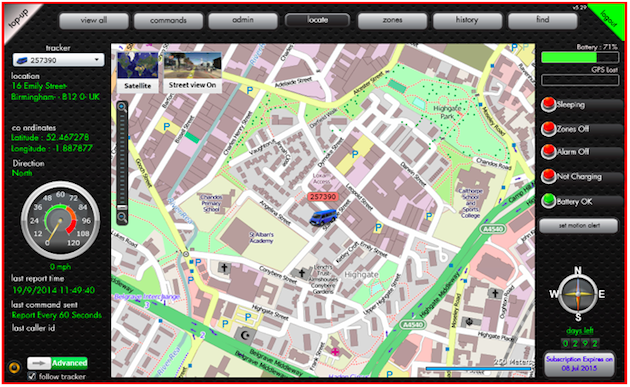
However, if I have magnetically fitted a tracker to the outside of his car, I will not lose the subject for long. It is a clever little device to keep me in the game. I don’t have to risk an accident or losing my driving license.
A tracker is simply a safer and more reliable adjunct to continuing a surveillance. It is not a substitute for actual eyes-on. Clearly, at some point, a series of compromising photographs or video will be needed as evidence. That’s when I will begin violating a subject’s privacy in earnest.
[quote align=”center” color=”#999999″]A tracker is simply a safer and more reliable adjunct to continuing a surveillance. It is not a substitute for actual eyes-on.[/quote]
When my subject gets to his destination and meets with someone, how do I find out who that someone is? If I am operating without a team, I cannot follow them both. But I might get the opportunity to put a second tracker on the other party’s car. I can download a history of that car’s movements at a later time.
There is some understandable unease amongst practitioners that tracking a vehicle remotely is unethical. They perceive a disconnect between following someone and tracking someone. I wonder why following and photographing a private individual is somehow acceptable but trackers are not?
I fear that if the law were to ban the use of trackers here, a logical corollary would be to outlaw the clandestine following and photographing of people. That would render our profession impotent.
In my view, trackers are not “cheating.” They are less obtrusive and less intrusive than physically spying on someone’s house and taking pictures of them with a long lens. If someone were following my daughter around and taking pictures of her, I would feel more violated than if they had fitted a tracker to her car. Especially because they would have been close enough to grab her.
Let’s not kid ourselves, ALL surveillance is an invasion of someone’s privacy to some extent. Surveillance of any kind is not a pretty thing. We PIs convince ourselves that it is OK, because it is legal. But deep down, we know it is sneaky. It’s just part of what we have to do to satisfy our client’s need for hard evidence.
A significant area of our job would be impossible without our preparedness to intrude on other people’s lives. Even if they are not aware of that intrusion.
I would like to think that PIs would only act in furtherance of noble causes. Sadly, we all know that it is not so. We often work for people who are motivated by money, jealousy or vindictiveness.
As principled PIs, we always need to apply our own ethics about on whom we spy, why we are spying and whom we are spying for. How we spy must always remain within the law.
I think of my tracker as I think of my camera or my car: It is just a piece of essential kit that makes my job safer and more effective.
I would not dream of listening in to a private conversation inside someone’s home. But I would deploy a device just to tell me where a motor car is.
This article was born of a posted reply to Brian Willingham’s piece, “GPS Tracking, The Law and The Future – A Private Investigator’s Take.” You can read Brian’s original article here.
About the Author:
Michael “Mick” Meaney is a PI in the United Kingdom and founder of Hyperion Investigations, an investigative company in Essex.