


By Philip Becnel
editor’s note: This is an experiment. We don’t generally publish fiction; it’s not really within our purview. But this short story by Philip Becnel detonated a mine in our brains and made us say, “OK, let’s ****ing do this.”
To avoid spoilers, we’ll just say this: If you’re anticipating the usual detective story tropes and payoffs, you will not find them here. Instead, brace yourself for a wild and twisty ride, with exit ramps that lead to sheer dropoffs, and a hapless hero eternally thwarted by absurdities.
Suspend disbelief and expectation. Strap in. Wear a helmet. And think about all the times you’ve sought the truth, come away empty-handed, and wondered about the broader meaning of it all — if any. Because in the real world of private investigations, that’s just how it goes sometimes.
This goes out to anyone who’s ever been jaded, broke, worn down, or driven a little bit mad by it all.
Private investigator Cole Trabalth steadfastly seeks The Truth in an absurdist, depersonalized near-future.
Like all good investigators, Cole Trabalth cared more for closure than “truth.” When his supervisor, Jake Elliot, called and ordered him on the next plane to Shreveport—hinting this lead might allow him to close that tedious case his agency had codenamed “the Vulture”—Cole said, “Thank you for this opportunity.”
“You’re the right man for the job,” Mr. Elliot said, as a car horn honked in the background. “This witness will make everything clear, at long last.”
Cole knew after twenty-five years on the job that no amount of investigation ever clarified anything. What little joy he derived from his job came from knowing, despite the futility of his work, that he was in fact very good at it. He held the phone to his ear and kept his mouth shut. Harper—his wife, who was nine months pregnant—thrust a packed suitcase into his other hand. Their son, sick with a pernicious cold, sniveled in a corner. Cole balanced the phone on his shoulder and wiped the boy’s nose with a handkerchief.
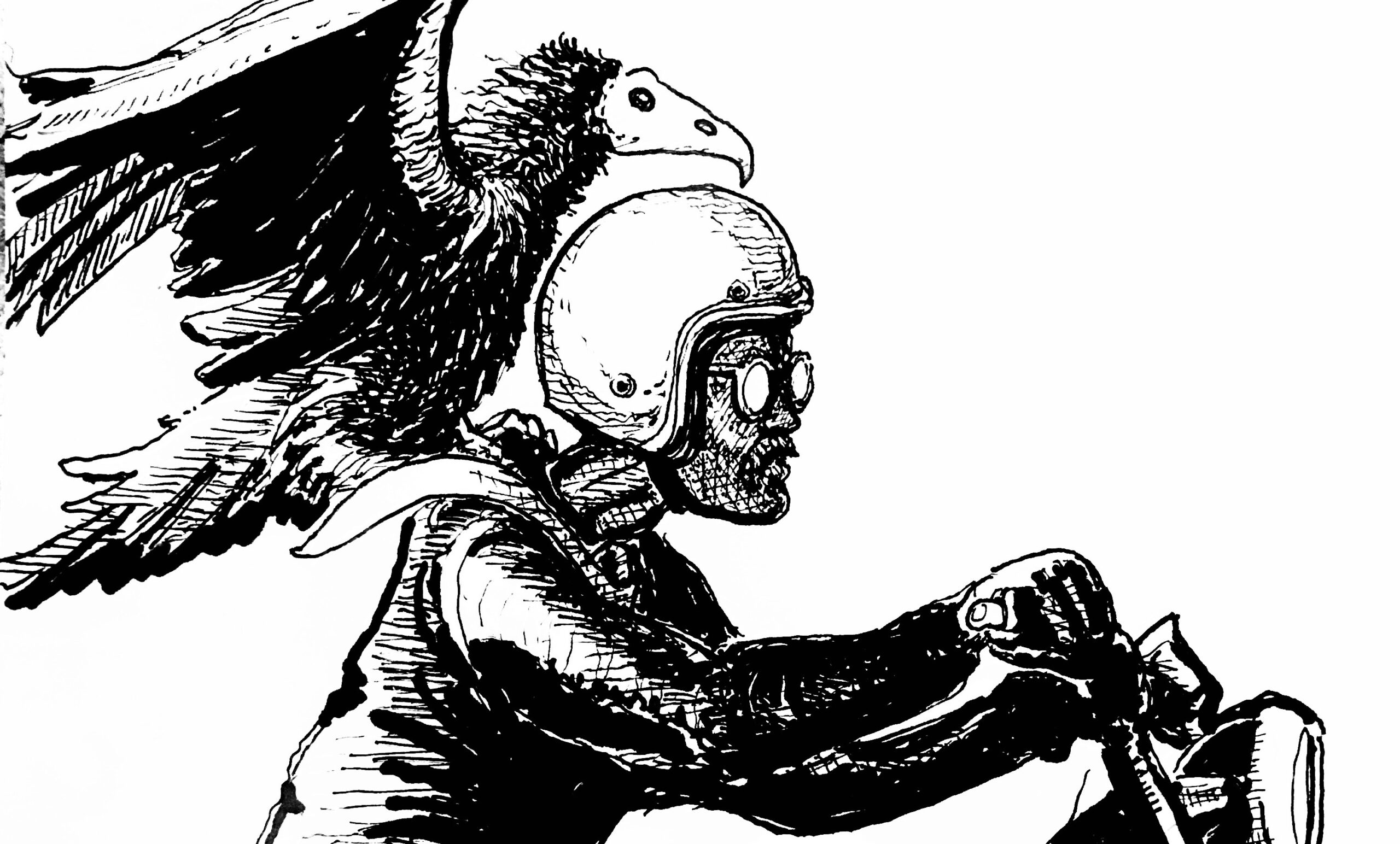
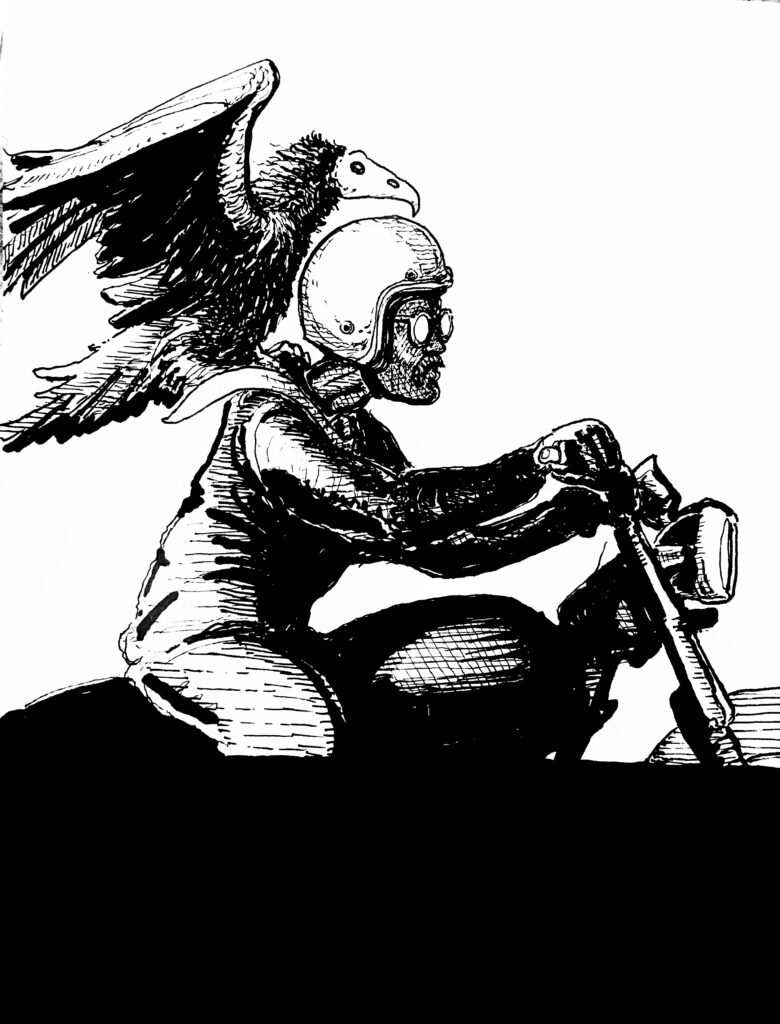
Harper then shoved Cole out the door. Outside, a man dressed in black leather waited atop a motorcycle, impatiently revving its engine. Cole, with the phone still wedged between his shoulder and ear, stuffed the soiled handkerchief in his pocket, strapped his suitcase to the back, and climbed onto the bike. No sooner had he straddled the seat than the driver twisted the throttle violently. The rear tire screeched, then grabbed the asphalt. Cole was nearly thrown from the back. They zoomed off just as Mr. Elliot, in a black sedan, pulled to a stop in front of Cole’s house, in the exact spot where the motorcycle had been.
“Oh, Jake!” came his wife’s voice over the phone.
Cole craned his neck just in time to see Harper and Mr. Elliot embrace. The bike then swerved almost horizontally around the corner. Cole allowed his weight to shift with the centrifugal force of the motorcycle. He clutched his free arm around the driver’s waist. Through the roar of the engine and the howling wind, he heard sounds on the phone that resembled a bird’s cooing. “Sir?” he said.
Mr. Elliot cleared his throat. “Just make sure you’re on that plane, Mr. Trabalth. I’ll send you information about the witness before you land.”
Over the driver’s shoulder Cole watched the speedometer reach 130 MPH as the motorcycle zigzagged between cars on the interstate. Cole disconnected the call, shoved the phone in his pocket, and held on tight. Within minutes the bike screamed into the airport, accelerated up a ramp, and jumped over the security fence à la Evel Knievel. Cole was let off at the foot of a staircase leading into a jet airplane. Without so much as a nod of the helmet, the rider tore off in the direction they had come. Cole fished out his phone and began to call his wife.
A flight attendant snatched the phone from his hand. “No phones on the tarmac, Mr. Trabalth. Hurry, now.” She steered him up the stairs and into a seat.
He had just the time to fasten his seatbelt before the jet roared up the runway. The tremendous g-force pulled Cole’s cheeks backwards into a tight grimace. They took off almost vertically. The agency, he thought, had spared no expense to unravel the secrets of the Vulture. He shuddered at the name of the case that had been the bane of his existence since he could remember. He already knew so much about the subject of his investigation, but thus far the mysterious truth had eluded him at every turn. He knew, for example, that the Vulture’s parents divorced when he was nine and that shortly thereafter he had mouthed off to his fifth grade teacher. In high school, shockingly, he defaced his Catholic school with spray paint and dropped out. His parents disowned him and he grew up in foster care, until at the age of eighteen he enrolled in college and graduated summa cum laude with a degree in philosophy. He thereafter started a small family and lived an apparently ordinary life, until at thirty-five, forthwith, his deviant tendencies resurfaced and he drew the ire of the investigative apparatus.
The plane’s intercom crackled. “Ladies and gentle-them, we will now begin a spiral descent—as a defensive maneuver, you understand—into the Shreveport Regional Airport. Please return to your seats and make sure your seatbelts are securely fastened.”
The plane pivoted sharply to the left and then corkscrewed down to the ground. The wheels screeched on the tarmac. The plane decelerated quickly and then stopped. The door was thrust open. Hot air, repugnantly sweet, wafted through the cabin. Cole was ushered up the aisle and shoved down an inflatable emergency chute. Another motorcycle waited for him at the end of the chute—only this time there was no black-clad rider. A solitary helmet rested on the bike’s handlebars. The humidity embraced him like a sweaty uncle.
Cole wiped the newly formed beads of sweat from his brow and looked up at the flight attendant. “Where’s the chauffeur? I don’t know how to ride a motorcycle by myself.”
She shrugged and shut the door. The plane began to taxi away. It was only then that Cole realized she never gave him back his phone and that he had left his luggage on the back of the first motorcycle. How could he receive Mr. Elliot’s instructions without his phone? How could Harper reach him if she was to have the baby in his absence?
Cole donned the helmet and hopped on the bike. But when he turned the key nothing happened. He thought back to the times when his agency had ferried him somewhere on the back of a motorcycle. On those occasions, the bike was already idling when he embarked. Desperately, he engaged various levers and buttons. The horn beeped, then the engine roared to life. He twisted the throttle—that much he knew. The bike sputtered several feet and lurched to a stop. He repeated this operation four times before he was finally able to keep the bike moving, albeit slowly, across the runway. He pointed the front tire at the plane, which had stopped on the far side of the airport. He twisted the throttle back as far as it would go. The engine whined. He intuitively knew he should upshift, but he had no idea how to do that. As he approached the plane, he realized he was also unsure how to brake. He squeezed a lever, then another. The bike jerked to an abrupt halt. However, in his surprise he forgot to retract his feet. The bike fell, pinning his leg to the ground.
As Cole struggled to get free, the plane thundered back to life and shot up the runway like a bullet.
“Wait! My phone!”
Now he would never solve the arduous matter of the Vulture. In his absence, Harper would solemnize her business with Mr. Elliot. Yes, it was time to give up, he thought, as he lay wedged between the motorcycle and the blisteringly hot tarmac—time for obscurity or death. He lay like this for some time, his head baking in the helmet, until he heard a chirp from under the bike. At this sign, he wiggled loose and reached into his pocket, where, to his tremendous relief, he found his phone. He must have forgotten that the flight attendant gave it back to him before they took off. He scrolled through his messages. Harper had inquired about the whereabouts of his robe and cigars. Mr. Elliot sent details about the critical witness, whose name, by a miraculous coincidence, happened to be the same as that of Cole’s mother—Sage Trabalth.
“You were always a bright boy, Cole—too bright. There’s a juncture at which intelligence becomes madness. What’s the point of all the investigations you’ve done? What sort of legacy are you leaving?”
—the detective’s mother
Cole responded to the messages, hefted the bike back onto two wheels, and started the engine. He then typed the witness’s address into his phone’s GPS and, balancing the phone between his thighs, rode in the direction of downtown Shreveport. Because he was unable to shift out of first gear, the trip took him three harrowing hours, and it was dark by the time he arrived at Ms. Trabalth’s abode—too late, for propriety’s sake, to knock on the door. He jotted down the tag number of an orange sedan in the driveway and then rode away to find a hotel for the night. He checked into a room on the ground floor and drank a shot of bourbon at the bar. He considered calling Harper, but it was too late. Instead, he returned to his room, set an alarm, and stared at the ceiling until he fell asleep.
The alarm jolted him awake well before dawn. He showered and shaved, then shuffled out to the parking lot. He started the motorcycle. The engine’s rumble echoed in the hotel parking lot. He shivered in his clothes, which were still wet from yesterday’s sweat. By a stroke of luck, he managed to upshift to second gear on the way there. However, unable to put the bike back in neutral, he stalled as he pulled up to the house. Ms. Trabalth’s car was gone. He knocked on the door anyway. Nobody answered. He returned to the motorcycle and warmed his hands near the manifold. It was odd, he thought, that the witness would leave home so early. Mr. Elliot’s message neglected to mention her occupation. Cole returned to the hotel, stalling repeatedly along the way. There, he set another alarm and slept until noon, then ordered a greasy meal at the bar and called Harper.
“Hi, darling! It looks like I won’t be home until tonight at the earliest. My witness left before I got there this morning.”
Harper sighed. “Your job is so boring. Here, talk to Jake…”
“He’s with you?”
“Hello, Mr. Trabalth,” came Mr. Elliot’s voice. “How are you getting along?”
Cole straightened up on the barstool. “No luck yet, sir—but I’ll get her.”
“Good, good.”
Cole mushed a blob of bacon fat with his fork. “Sir, if you don’t mind me asking, what are you doing at my home?”
“I don’t like what you’re insinuating, Mr. Trabalth. Your wife is about to burst, as you well know. I simply came by to check on her—as a favor to you.”
“There is no insinuation, Mr. Elliot. I couldn’t be more grateful for everything you’ve done for me at the agency. Would you mind putting my wife back on the phone?”
“I’m afraid that’s impractical. She’s quite busy now. Besides, you should be interviewing that witness. This case isn’t going to solve itself.”
They hung up. Cole paid the bill and plodded back to Ms. Trabalth’s abode. This time, as he sputtered to a stop in front of the house, the orange sedan he had seen in the driveway earlier turned the corner, entering the other side of the block. Upon seeing Cole, the driver, a woman with gray hair and sunglasses, pulled a quick U-turn and sped away. Cole started the bike and raced after her. He saw the car on a straightaway as he rounded the first corner. He kicked upward with his foot and managed to shift into third gear. The car slowed for a red light. He pulled along beside it. The witness rolled down the window and flicked a cigarette butt, which bounced off his helmet. He was considering how to respond to this unique indignity when the light turned green. The car sped off. He let out the clutch and twisted the throttle, but he forgot to first downshift. The bike stalled. Hopelessly, Cole watched the orange car disappear up an onramp.
He returned to the witness’s house. There, he took the handkerchief from his pocket and wiped his son’s snot on the doorknob. If his son’s symptoms were any indication, the lady would soon be bedridden for a week. Cole then returned to the hotel and got drunk at the bar.
At two o’clock in the morning he rode back to the witness’s house, but this time he parked his bike a block away, where he could still see the house. The orange sedan was there. He crept to the driveway and let all the air out of its tires. He then returned to the motorcycle, where he waited several hours, warming his hands on the engine’s residual heat. At dawn he pushed his bike in front of the house and knocked on the door.
A puffy-eyed woman in her sixties answered wearing slippers and a bathrobe. “You’ve got me,” she said. “I’m too sick to dodge you any longer.”
Cole nearly fell over. This woman was his mother, who he had long assumed to be dead. She was way older than the most recent photograph he had seen, but there was no mistaking it. She had the same blue eye shadow and ruddy cheeks, and she wore the same cross around her neck. He said, “My social worker told me you were dead.”
“Not yet. Your Dad’s dead. He drowned under a sea of letters from his many admirers.” She cackled and then sneezed into a handkerchief. “What do you want?”
“I’m here about… the Vulture.”
“I see. I suppose it’s about time. Come in. Would you like some coffee?”
“Yes.” He followed her into the kitchen and lingered nearby as she poured their drinks, to make sure she didn’t poison him. “What can you tell me?”
She handed him a cup on a saucer, and they sat across one another at a table in the kitchen. She sneezed and then lit a cigarette. “You were always a bright boy, Cole—too bright. There’s a juncture at which intelligence becomes madness. What’s the point of all the investigations you’ve done? What sort of legacy are you leaving?”
“People read my reports, I think. They have a purpose, an audience who will refer to them when I’m gone.”
“A more suitable audience for you would be a psychiatrist.”
“Cut the crap, Ms. Trabalth. Tell me about the Vulture.”
She took a drag from the cigarette and sipped her coffee. “What do you want to know?”
“Everything.”
She snuffed out the cigarette in an ashtray. She opened her mouth, closed it, and then opened it again. But before she could speak Cole’s phone rang.
He fished the phone from his pocket to silence it when he noticed the call was from his supervisor. “Hello, Mr. Elliot. I’m with the witness now.”
“Never mind that. We just ran out of funding. The investigation is called off. You can submit your report to me tomorrow. Your flight home leaves in an hour. Also, Harper has had the baby—a beautiful girl!”
Cole disconnected the call and turned to his mother. “It seems we have nothing left to talk about, and I have a plane to catch, so I must go.”
“It’s just as well,” she said.
They stood and she walked him to the door. “Someone’s flattened your tires,” he said, gesturing to her sedan.
They said goodbye. Cole climbed on the bike and started the engine. He engaged first gear and deftly zoomed out of the neighborhood. He engaged second and then third, past the light where his mother had flicked the butt at him. It had taken him a couple days, but he had finally gotten the hang of the motorcycle. He took the onramp and engaged fourth, riding now at a steady clip. If his journey to Shreveport was any indicator, if he could just make it back to the airport on time, the remarkably fast jet was sure to have him home before Harper left the hospital.
Yes, Cole thought, he actually loved being an investigator, despite his burnout—the challenge of the pursuit, the superiority of knowing he was at least a step closer to the truth than the average person.
—the detective
When he entered the freeway, however, he encountered a sea of bumper-to-bumper traffic. He veered onto the shoulder to pass, but some of the cars pulled into his path and opened their doors so he couldn’t get by. He returned to the lane and waited with the rest of the vehicles, his feet planted on the asphalt, the engine idling. Sweat poured down his face. The traffic inched forward at a snail’s pace for forty-five minutes, only dispersing when he was within a couple exits of the airport. Once he had an opening, he twisted the throttle, shot around a gaggle of cars, upshifted all the way to fifth, and zoomed into the airport loading-zone with only a few minutes to spare. This airport had no Evel Knievel ramp, so he had to park his bike outside the fence and wait in a security line with all the other travelers. By the time he made it to his gate, the plane had long ago departed.
“Mr. Trabalth,” a gate agent said, “we waited for you as long as we could.”
“When is the next flight?”
“It’s not until next Tuesday, I’m afraid.”
Cole called Mr. Elliot and told him he missed the plane. “Aren’t there any other options to bring me home sooner than next Tuesday?”
“Because funding for the Vulture has been suspended, you’re lucky we can arrange to bring you home at all. We don’t even have it in the budget to get you a hotel while you wait.”
“But sir, Tuesday is three days from now!”
“I don’t care for your tone, Mr. Trabalth—not one bit. If being an investigator was easy, everyone would be one. We’ll talk about your next assignment when you return.”
After they hung up, Cole called Harper, but she didn’t answer. He then walked to the nearest bar and ordered bourbon. As he settled onto the barstool, he became conscious of how bad he smelled, like a goat doused in vinegar. He decided to retrieve the motorcycle and find a place more interesting than the airport to spend his next three days in Shreveport. He downed the bourbon, got the bike, and shot out of the airport as if he had somewhere to go. He muddled through second and third gears, weaving in and out of traffic, but when he reached the highway he upshifted swiftly, passing the other vehicles on the shoulder. The breeze on his face felt exhilarating. He took a random exit and veered onto a desolate rural highway lined with pine trees as far as he could see. A black bird soared high overhead. Cole pegged the speedometer at 110 MPH, which was as fast as he dared go.
As he roared past the endless rows of pines, he mulled over the now-closed investigation and his many years of loyalty to the agency. Despite his initial disappointment at being stuck in Louisiana, he was glad to be done with that dreadful case. It was always better, he thought, that a case end abruptly than drag on forever, no matter the outcome. As he spotted a deer standing on the side of the road up ahead, the kernel of a thought popped into Cole’s mind: that, notwithstanding the deleterious impact his work had caused on his marriage and mental health, he was proud to have cornered his mother and come so close to uncovering the Vulture’s secret. He let up on the throttle a bit and locked eyes with the deer as he rapidly approached.
Yes, Cole thought, he actually loved being an investigator, despite his burnout—the challenge of the pursuit, the superiority of knowing he was at least a step closer to the truth than the average person.
He had no time to react when the doe leapt straight into his path.
About the Author:
Philip Becnel is the managing partner of Dinolt Becnel & Wells Investigative Group LLC and is the author of Introduction to Conducting Private Investigations and Principles of Investigative Documentation. Philip is a licensed private investigator in Virginia, West Virginia, Maryland and Washington, D.C.