



Creating a successful business from scratch is all about quality ingredients, great stories, and keeping the fires lit.
I love food.
I am one of those guys who would be happy to spend my Saturday at a farmers market just to browse the latest seasonal vegetables.
On trips abroad, I can’t wait to visit the supermarket to see the interesting things that don’t exist in my own local grocer.
And when I visit new places, I almost always plan my day around the places I want to eat.
This habit drives my wife nuts, but I will probably never change. Because to me, food is the lifeblood of a culture. Trying new flavors is about more than just the eating; it’s about the traditions, the company, and the stories and laughter shared at the table.
I love eating good food with all my heart, but what I love even more is cooking it.
I’ll go to seven different places to source the best ingredients, from the bread to the seafood, to the locally grown vegetables and grass-fed meats, to the beer and wine. It’s my little escape from the daily hustle and bustle.
I haven’t always been that way. But on the Italian side of my family, cooking was the center of everything. And my grandmother from the other side of my family was a dead ringer for Julia Child.
So I guess it’s in my DNA.
Much to my siblings’ chagrin, I would watch Julia Child, Jacques Pepin and Jeff Smith of the Frugal Gourmet on PBS every week.
They still hate me for it.
I didn’t really start cooking until my 20s, when I met my wife. But over the years, my cooking skills have expanded beyond the burnt basmati that I served her on one of our first dates. Despite not having any formal chef training, I have even considered opening a restaurant. But only one that would be open on Sundays and would serve whatever I felt like cooking that day, family style at one big table. You get what you get, you share it, and you don’t complain.
At my restaurant, the chef would always be right.
I’m pretty sure a restaurant like that would close in a matter of weeks, so the idea has never really gotten off the ground.
But I still love cooking. One of the dishes I have spent years mastering is paella. I learned it from my father-in-law, who was “made in Spain” (as he would say) but was born and raised in New York. He came from Valencia, where paella was born.
Paella comes from the name of the wide and shallow pan that it’s cooked in, a paella. The dish is mostly rice, and usually includes some local, fresh ingredients. So if you lived near the sea, you might throw in some seafood and vegetables; but if you lived inland, you’d add rabbit, chicken, snails and beans.
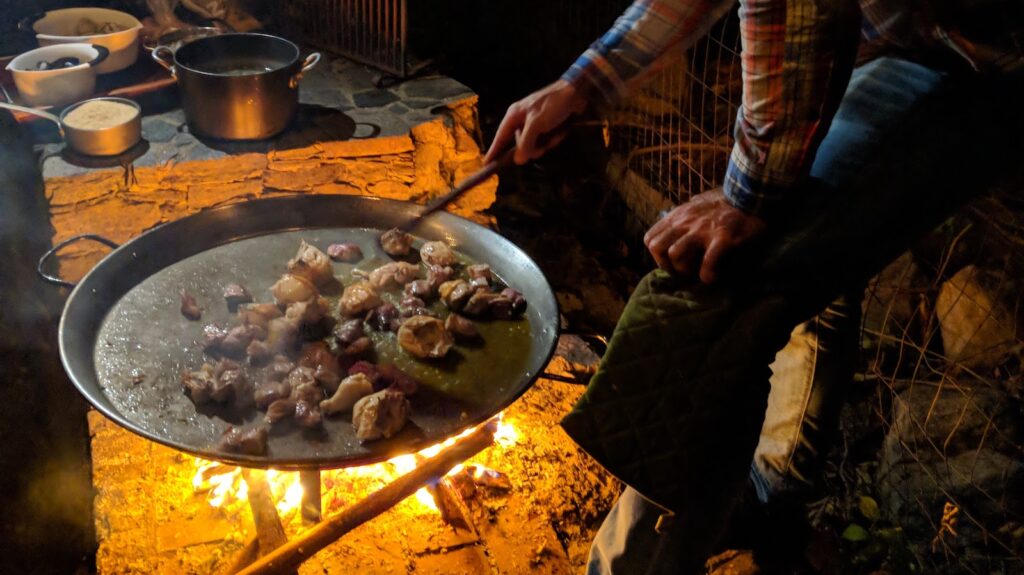
The beauty of a paella is the communal experience of making it. There’s lots of prepwork, then a fire to build and stoke, and obviously, stories to tell. As my father-in-law stoked his paella fire, he would tell me all about eating at La Pepica in Valencia as a kid. About how the New York Times showed up to his brother’s house in the 1960s, to profile the family and their paella recipe, which ended up in the New York Times cookbook.
My father-in-law once even told me his “secret” ingredient. He would spike the sangria with some flavorless alcohol, so even if the paella turned to shit, everyone would have a great time.
Memorial Days at my father-in-law’s Cape Cod house were epic. From what I can remember.
My father-in-law passed away last year, but his paella tradition has lived on.
For years, he schooled me in the art of making paella. First, I served as the fire man, helping to tame the fire at the right moments. Then, I might be lucky enough to go shopping for the ingredients; do a half-day’s prepwork; stir the vegetables or help add a few shots of brandy into the sangria.
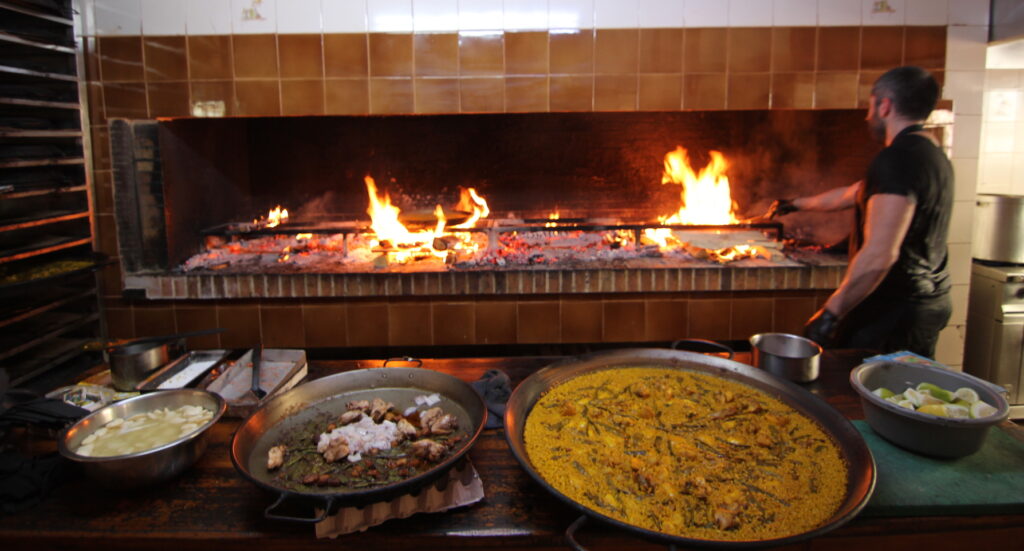
Until finally, I was given the reins to make my own paella.
I’m pretty sure that my first few paellas weren’t all that great, but at some point, I became pretty good at it. In fact, I think I might have gotten a bit cocky. And then one day, a Spanish-American cousin came over for paella. He watched me cook for hours.
I was eager for him to taste it.
“It’s got good flavor,” he said, “but it has no soul.”
He noted the canned tomatoes, frozen lima beans, Uncle Ben’s rice, boxed chicken stock and the cheap Goya seasoning I substituted for saffron, the spice known as “red gold,” the most expensive spice in the world.
I was crushed. What did he mean, no soul?
Paella is a rice dish cooked in a pan. Of course it doesn’t have a fucking soul.
The Soul of Paella
But when it’s done right, paella does have a soul. It’s got a story.
Paella was farm laborers’ fare prepared over a wood fire at lunchtime in the temperate climate of Valencia, where rice grows plentiful. It’s got hand-picked saffron from La Mancha, which was originally brought from North Africa by the Moors over a thousand years ago. Paella is meant to be made with seasonal vegetables, like fresh artichokes in the springtime.
Yes, it’s a rice dish cooked in a pan. But it’s the fresh Valencian ingredients, origin stories, and open-flame cooking in a flat-bottomed pan that make it a paella. And each individual paella that someone cooks has its own individual story, too — families chopping tomato, onion, and garlic, sneaking in “secret” ingredients, communing around the fire, and honing their family recipe.
Most of the recipes by famous chefs like Jamie Oliver and Gordon Ramsey aren’t paella at all. They are what the Valencians call “arroz con cosas,” or “rice with things.”
I had been making rice with things and calling it paella.
But what I learned from years of watching others make paella was that it wasn’t just rice with things. It had a story. It had memories and experiences. It had a soul.

I use fresh tomatoes now and make my own chicken stock. I try to source the best ingredients, including the famous bomba rice from Spain.
And I do it while channelling my father-in-law. Telling my own stories of living in Spain, of the regional dishes I ate, and of how I came to make my own version of the classic dish.
The mark of an advanced-level paella — the BEST part of the paella, by most accounts — is the socarrat, those crusty bits of almost-burnt rice that stick to the bottom of the paella pan. It is very satisfying to achieve a perfectly cooked paella, complete with tasty, crunchy socarrat. It took years of sweating over a fire to learn this trick.
So what does this all have to do with building a company?
I think businesses miss a giant opportunity when they fail to tell stories that describe the soul of the company. How it came to be. And most of all, why it came to be.
That’s the personality of the business, its mission and origin story.
I “fell” into the private investigation business by a half-accident. Only after failing miserably at several things (including college the first time around) and having my dreams of being a professional baseball player flame out. In 2001, I took a job working with my father’s private investigation firm while trying to figure out my next step, but ended up staying there for eight years.
I started my own business 12 years ago with equal parts excitement and terror. I had left a firm that taught me everything I knew about investigations. And I started a business to not only scratch my entrepreneurial itch, but to prove that I was not just the boss’s son.
I wanted to build a company using a fresh attitude of openness, transparency, and a side of snarkiness — while doing some amazing professional work. I had this idea of changing this industry’s “cloak and dagger” image of secret sources, magical powers, and inside intelligence. And I wanted to challenge the idea that former law enforcement officers were the only ones who could do this job well. I wanted to make my own schedule, do the work that I wanted to do, and create a healthier work-life balance.
I’m still working on that work-life balance thing.
That’s the soul of my company, our story: what I learned from the early failures and false starts, the family business years-in-training, the radical transparency with a socarrat of crusty snark. These ingredients infuse everything we do, from our website to our social media to our daily communications with clients.
That story is not going to be compelling for everyone. It might actually piss a few people off. Like the people who want someone who plays to the myth of all those mystical databases. People who want a dark-arts magician willing to conjure bank records, medical records or hack into social media accounts. Or people who believe they should only hire someone with law enforcement experience.
But that message that might create a few frenemies, it’s going to be music to the ears of the people I want to attract. I’m not trying to win over everyone; I’m just trying to win over a few rabid fans who will go into battle with me.
I know my audience. My story is for them.
The Soul of a Business
I don’t know about you, but I often find myself attracted to businesses, artists and brands that have a story. Like my friend Paul Cunningham, a Cooperstown, New York native who quit his job at Major League Baseball to make handmade leather baseballs. Or Oxford Pennant, founded by two guys in Buffalo who bonded over the nostalgia and ingenuity of pennants and became instant friends. Or the musician MIKE, a former pitcher who holds the all-time lowest earned run average for Duke University, but blew out his arm and became — wait for it — a rapper.
I know it’s not easy to connect cooking paellas with branding a business, or to get your head around what rappers from privileged backgrounds have to do with anything.
So let me leave you with this:
Would you rather come to my house to enjoy some rice with things?
Or would you rather have an authentic Valencian paella with fresh artichokes (and a hint of rosemary) that I learned to make while living in Spain, inspired by my father-in-law’s tiny Spanish village with Moorish roots in the heart of the region where paella was born?
Oh, and it’s got a perfect amount of crispy socarrat, a nice bottle of wine from Ribera del Duero, and maybe even a little brandy-spiked sangria on the side.
If you’re down with that second story, you’re my audience. I’m talking to you.
Come on by. Hell, I might even let you stoke the fire.

About the Author:
Brian Willingham is a New York private investigator, Certified Fraud Examiner, and founder of Diligentia Group. To read more Willingham wisdom, check out his blog and his previous stories for PursuitMag.